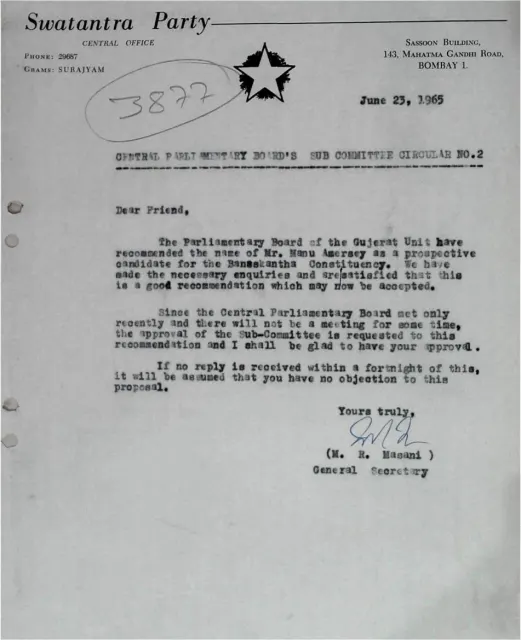
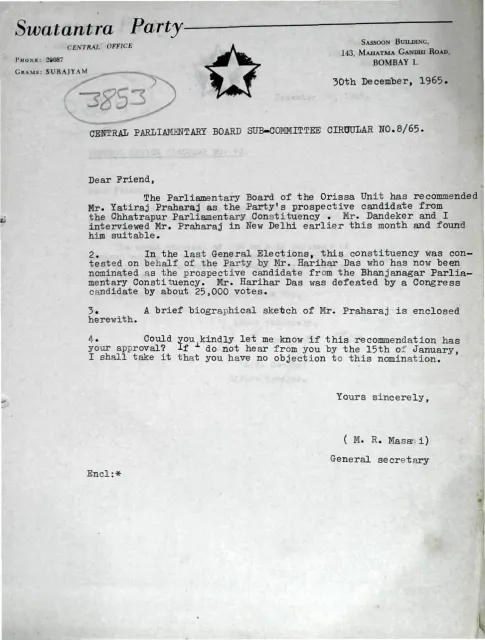
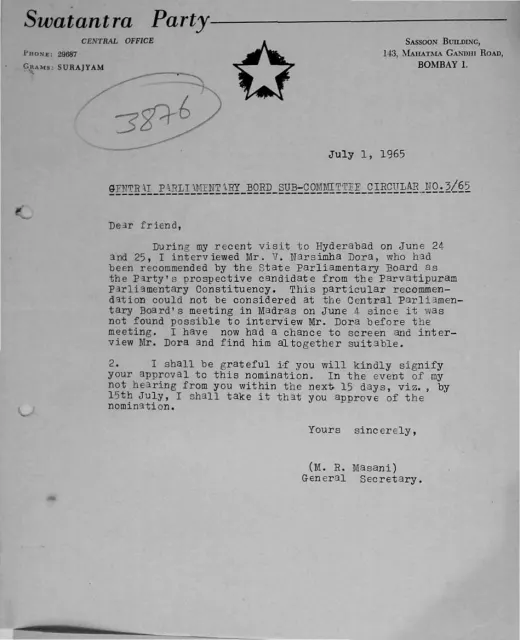
circular
Central Parliamentary Sub-Committee Circular No.7/65
By Minoo Masani
Swatantra Party—Central Office · Bombay 1 · 1965
2 pages
Summary
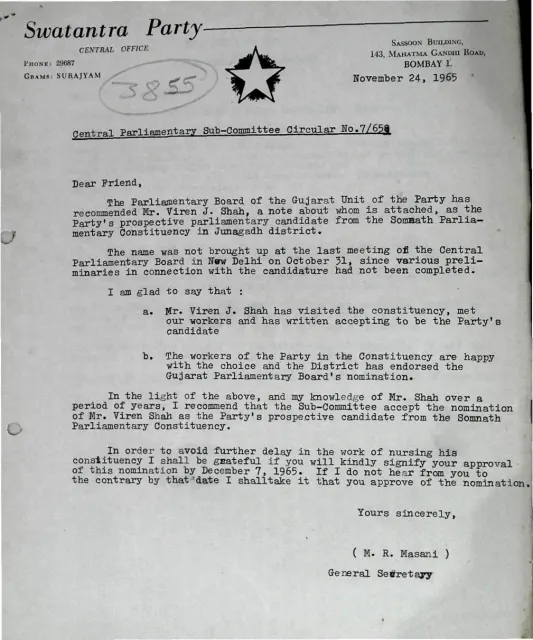
This two-page Swatantra Party circular, dated November 24, 1965, recommends Viren J. Shah as the party’s prospective parliamentary candidate for the Somnath constituency in Junagadh district. Signed by General Secretary M. R. Masani, it explains that Shah’s candidacy had been deferred at the Central Parliamentary Board’s October 31 meeting because preliminary work was incomplete. The Gujarat unit subsequently reported that Shah had visited the constituency, met party workers, accepted the nomination, and received district-level endorsement.
The circular asks the Central Parliamentary Sub-Committee to approve the nomination by December 7, 1965, indicating that silence by that date would be treated as approval. The attached biographical particulars present Shah, aged 39, as a Bombay industrialist and office-holder in several steel and manufacturing bodies, with management training in the United States. They also highlight his participation in the 1942 Quit India movement and his work in the liberation of Junagadh, including service as a secretary of the Junagadh Rajya Praja Mandal.
Key points
- The document is a Central Parliamentary Sub-Committee circular issued by the Swatantra Party’s Central Office on November 24, 1965.
- M. R. Masani recommends Viren J. Shah as the party’s prospective candidate for the Somnath Parliamentary Constituency in Junagadh district.
- The nomination had not been considered at the October 31 Central Parliamentary Board meeting because preliminary arrangements were incomplete.
- Shah had visited the constituency, met party workers, and written to accept the party’s candidacy.
- The Gujarat Parliamentary Board and district workers endorsed Shah’s nomination.
- The circular requests approval by December 7 and states that no contrary response by then would be treated as approval.
- The attached biography describes Shah’s industrial leadership, management education, participation in the 1942 Quit India movement, and involvement in Junagadh’s liberation.
Metadata and summary are AI-extracted from the source PDF and reviewed for editorial accuracy. The original work is available via the Read PDF tab above (where present); paragraph-level citation inside the PDF is deferred to a future engagement.