letter
GENERAL SECRETARY'S LETTER NO.106
By Minoo Masani
Swatantra Party, Central Office, Sassoon Building, 143, Mahatma Gandhi Road, Bombay 1. · Bombay · 1965
8 pages
Summary
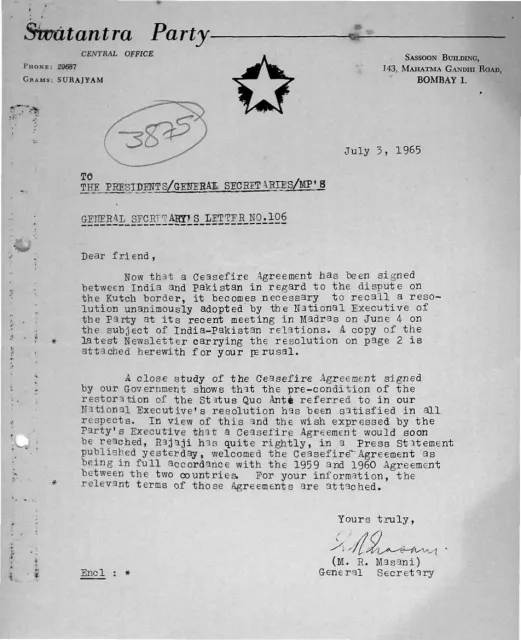
This July 3, 1965 circular from M. R. Masani recalls a Swatantra Party National Executive resolution on India-Pakistan relations after the Kutch ceasefire agreement. Masani argues that the agreement satisfies the resolution’s precondition for restoring the status quo ante and notes C. Rajagopalachari’s view that it accords with the 1959 and 1960 agreements. The letter encloses the relevant agreement extracts and asks party office-holders to circulate the material.
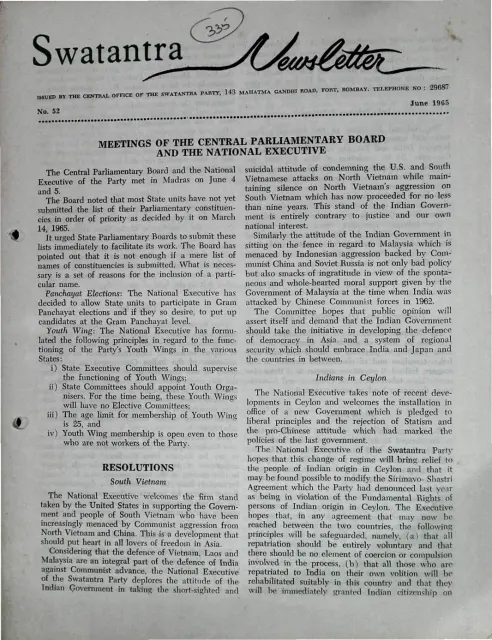
The accompanying June 1965 Swatantra Newsletter presents the party’s positions on foreign policy, domestic economic policy, and party organisation. Its resolutions support South Vietnam and regional security cooperation against Communist expansion, criticise the Indian government’s stance on Malaysia and Ceylon, and condemn what it describes as Communist and obscurantist influence within Congress. It also advocates social justice, secure agricultural tenure, remunerative farm prices, lower taxes, and an end to state monopolies over diesel-oil distribution. Reports from state units describe voter education, party training, organisational expansion, and defections from Congress and the Praja-Socialist Party. The newsletter concludes with Masani’s and Rajagopalachari’s attacks on Congress dominance and the government’s foreign-policy and economic record. The final enclosure reproduces extracts from the 1959 and 1960 Indo-Pakistan agreements concerning negotiation, tribunals, and the Kutch-Sind boundary.
Key points
- Masani circulates a National Executive resolution linking the Kutch ceasefire agreement to restoration of the status quo ante.
- The newsletter endorses South Vietnam and calls for an Asian regional-security arrangement involving India, Japan, and neighbouring countries.
- The Swatantra Party criticises Indian policy toward Malaysia, Ceylon, and Communist China, and urges a more explicitly anti-Communist foreign policy.
- Domestic resolutions combine support for social justice with opposition to statism, state monopolies, high indirect taxation, and restrictive import policy.
- Agricultural demands include secure tenure, remunerative prices, timely supplies of inputs, credit, and abolition of excessive land revenue burdens.
- The newsletter reports party-building activities, youth-wing rules, voter education, worker training, and defections from Congress and the Praja-Socialist Party.
- The enclosed Indo-Pakistan extracts document commitments to negotiation or impartial adjudication of boundary disputes.
Metadata and summary are AI-extracted from the source PDF and reviewed for editorial accuracy. The original work is available via the Read PDF tab above (where present); paragraph-level citation inside the PDF is deferred to a future engagement.