letter
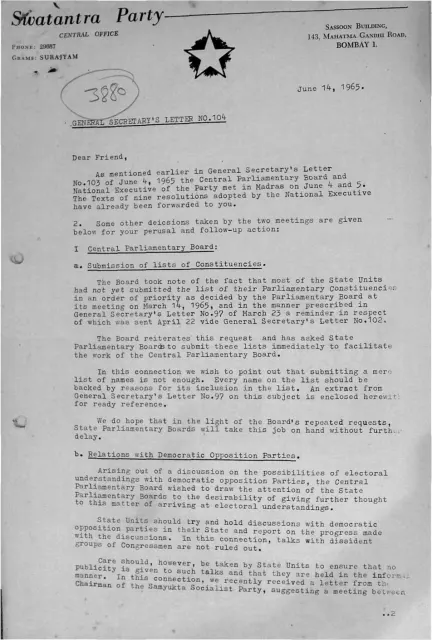
GENERAL SECRETARY'S LETTER NO.104
By Minoo Masani
Swatantra Party — Central Office · Bombay · 1965
2 pages
Summary
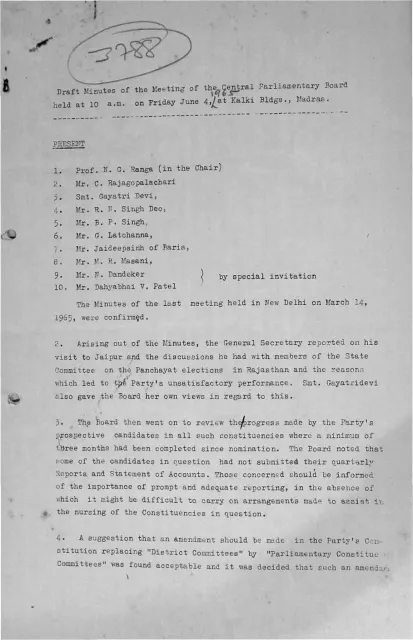
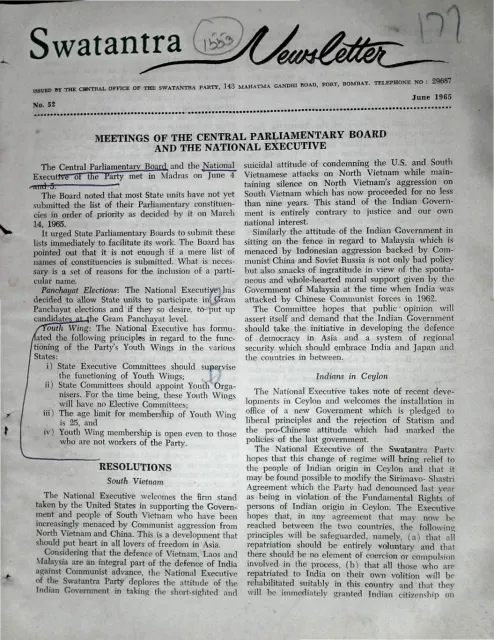
Dated June 14, 1965, this General Secretary’s Letter reports decisions taken by the Swatantra Party’s Central Parliamentary Board and National Executive at meetings in Madras on June 4–5. It asks State Parliamentary Boards to submit prioritized lists of parliamentary constituencies, with reasons supporting each proposed candidate, and urges them to explore electoral understandings with democratic opposition parties while keeping such discussions confidential. The letter also notes the Party’s position on associating with the Swatantra Socialist Party in light of Indo-Pakistan relations and the Kutch issue.
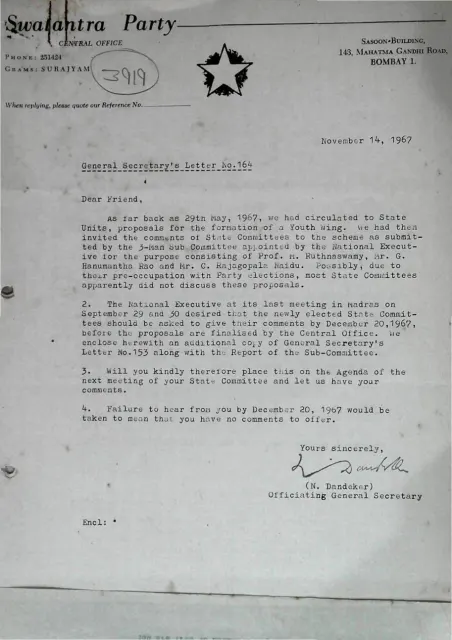
The National Executive further authorized State Units to contest Gram Panchayat elections on the Swatantra Party label. It outlined arrangements for the Party’s proposed Youth Wing: State Executive Committees should supervise it, State Committees should appoint Youth Organisers, membership should be limited to those aged 25 or below, and non-party workers should also be eligible to join. The document is signed by M. R. Masani as General Secretary.
Key points
- The letter communicates follow-up decisions from Swatantra Party meetings held in Madras on June 4–5, 1965.
- State Units are instructed to submit prioritized lists of parliamentary constituencies and justify each proposed name.
- The Central Parliamentary Board encourages discussions with democratic opposition parties about electoral understandings.
- The letter refers to the Party’s difficulties in associating with the Swatantra Socialist Party in the context of Indo-Pakistan relations and the Kutch issue.
- State Units are given the option to contest Gram Panchayat elections using the Swatantra Party label.
- The proposed Youth Wing is to be supervised by State Executive Committees, with appointed organisers, a maximum membership age of 25, and eligibility for non-party workers.
Metadata and summary are AI-extracted from the source PDF and reviewed for editorial accuracy. The original work is available via the Read PDF tab above (where present); paragraph-level citation inside the PDF is deferred to a future engagement.