Summary
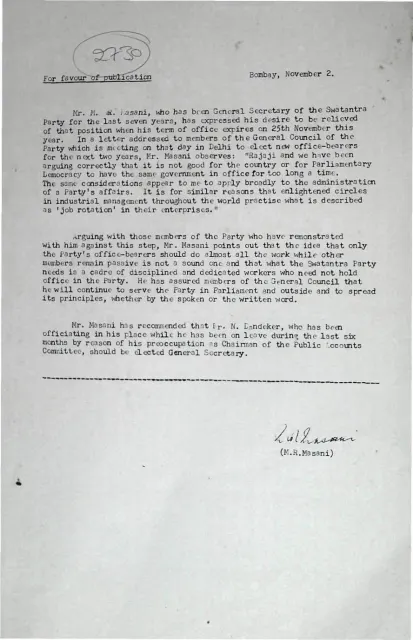
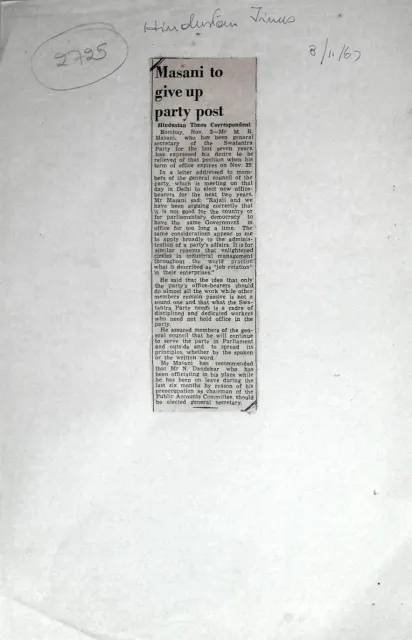
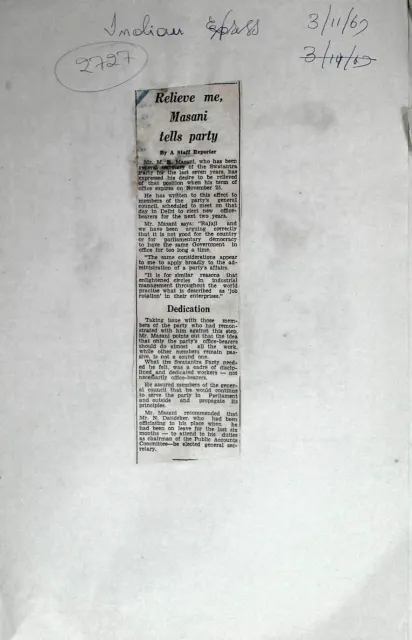
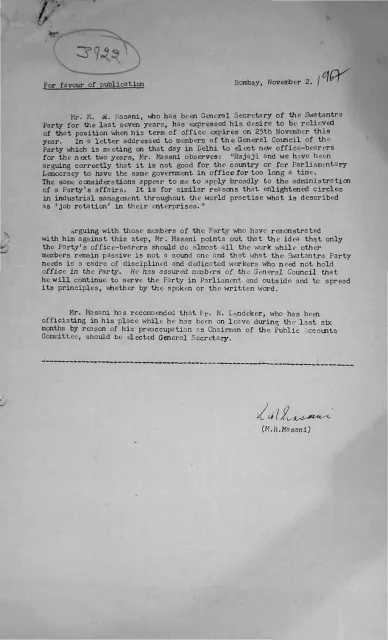
This four-page English archival document, dated November 1–2, 1967, records M. R. Masani’s decision not to seek another term as General Secretary of the Swatantra Party. After seven years in the position, Masani argues that both parliamentary democracies and political parties benefit from changes in leadership. He compares this principle with “job rotation” in enlightened industrial management and says that party administration should not depend on a small number of office-bearers doing nearly all the work.
Masani presents his resignation as a contribution to organisational renewal rather than a withdrawal from public life. He promises to continue serving the party in Parliament and outside it, spreading its principles through speech and writing. The accompanying press note and letter recommend Mr. N. Landeker, who had been officiating during Masani’s six-month leave as Chairman of the Public Accounts Committee, for election as the next General Secretary. The document engages directly with C. Rajagopalachari (“Rajaji”) and reports Masani’s appeal that Rajaji and the party president not insist on his continuation.
Key points
- M. R. Masani announces that he wishes to leave the Swatantra Party’s General Secretary position when his seven-year term expires on November 25, 1967.
- He argues that regular changes in leadership are healthy for parliamentary democracy and for the administration of political parties.
- Masani invokes “job rotation” in industrial management as an analogy for party leadership rotation.
- He rejects the idea that party office-bearers should perform almost all organisational work while other members remain passive.
- He calls for a large cadre of disciplined and dedicated workers, including members who do not hold formal office.
- Masani states that he will continue serving the Swatantra Party in Parliament and outside it.
- The document recommends Mr. N. Landeker as the next General Secretary.
Metadata and summary are AI-extracted from the source PDF and reviewed for editorial accuracy. The original work is available via the Read PDF tab above (where present); paragraph-level citation inside the PDF is deferred to a future engagement.