circular
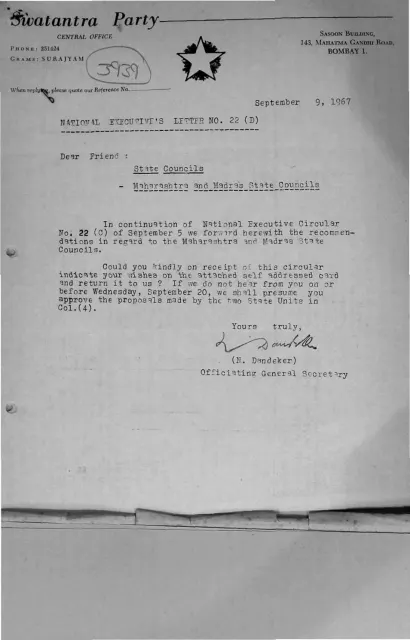
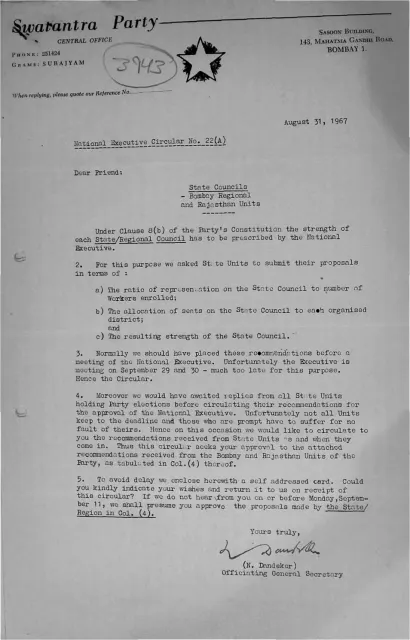
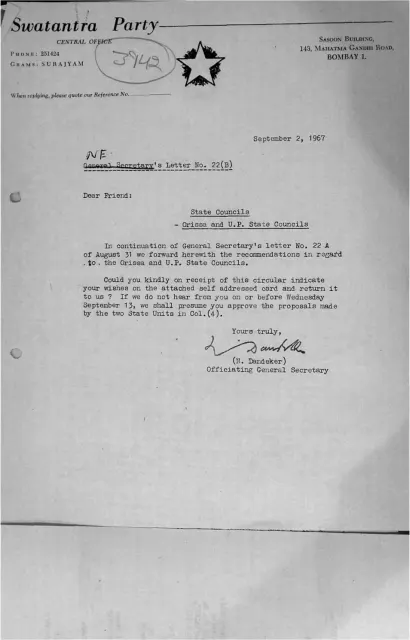
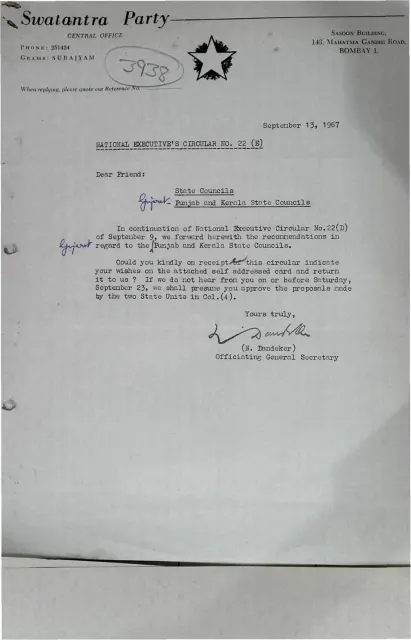
NATIONAL EXECUTIVE'S CIRCULAR NO. 22 (E)
By N. Dandekar
Swatantra Party CENTRAL OFFICE · Bombay · 1967
3 pages
Summary
Dated September 13, 1967, this Swatantra Party National Executive circular forwards recommendations concerning the Punjab and Kerala State Councils. Signed by N. Dandeker as Officiating General Secretary, it asks recipients to indicate their wishes on an attached self-addressed card and states that, without a response by September 23, approval of the proposals will be presumed.
The attached tables set out proposed representation ratios and seat allocations based on the number of workers enrolled in each organised district. For Punjab, the proposal provides two representatives for the first 50 workers and one additional representative for every 20 workers thereafter, subject to a maximum of 10 per district unit, producing 46 allocated seats. Kerala’s proposal uses two representatives for the first 15 workers and one for every additional 10, also subject to a maximum of 10 per district unit, producing 55 seats. A further table for Gujarat proposes two representatives for the first 100 workers and one additional representative for every 100 workers thereafter, with a maximum of 10 per district unit, producing 127 seats. The document therefore records an internal party-administration exercise in distributing state-council representation according to unit membership strength.
Key points
- The circular is dated September 13, 1967 and issued from the Swatantra Party Central Office in Bombay.
- It concerns recommendations for the Punjab and Kerala State Councils, with a Gujarat table attached as part of the same proposal.
- Recipients are asked to return their wishes on an attached self-addressed card.
- The circular presumes approval if no response is received by Saturday, September 23.
- Punjab’s proposed formula yields 46 allocated seats across listed district units.
- Kerala’s proposed formula yields 55 allocated seats across listed district units.
- Gujarat’s proposed formula yields 127 allocated seats across listed district units.
- Representation is calculated from the membership strength of organised workers in each district unit.
Metadata and summary are AI-extracted from the source PDF and reviewed for editorial accuracy. The original work is available via the Read PDF tab above (where present); paragraph-level citation inside the PDF is deferred to a future engagement.