programme · position paper
A note from Dr. R. C. Cooper, Hon. Treasurer, Swatantra Party on some aspects of the A.I.C.C.'s Ten Point Programme
With the Compliments of Swatantra Party Central Office · Bombay
4 pages
Summary
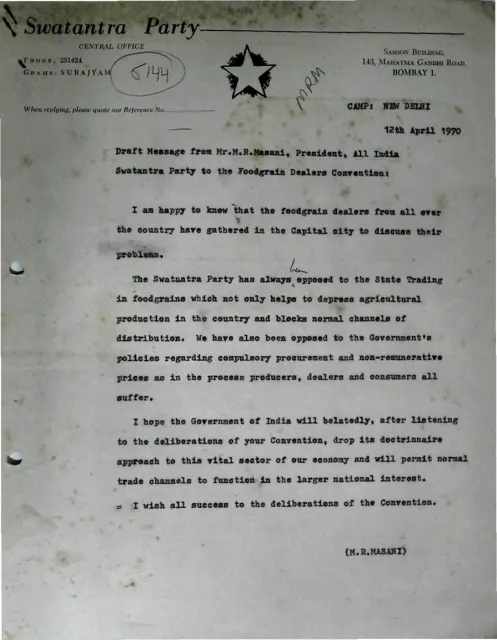
This four-page Swatantra Party note by Dr. R. C. Cooper challenges economic provisions in the All India Congress Committee’s Ten Point Programme, particularly state trading in foodgrains and the progressive nationalisation of import and export trade. Cooper argues that these measures do not address the country’s urgent economic problems and may instead make the business community a scapegoat for failures of government policy. The note focuses especially on the proposed takeover of retail trade and asks the press to present the relevant evidence to the public.
Cooper supports his case with comparisons of retail margins and prices for petrol, high-speed diesel, kerosene, and rationed foodgrains in Bombay and other cities. He contends that dealers’ commissions have fallen or remained fixed while prices, interest rates, establishment expenses, licensing obligations, and transport costs have risen sharply. The closing argument invites the public to judge whether the A.I.C.C.’s decision is fair to business and whether state trading in foodgrains will actually benefit India’s masses. The document is issued by the Swatantra Party Central Office in Bombay; no publication year is printed.
Key points
- The note criticises state trading in foodgrains and progressive nationalisation of import and export trade.
- Cooper argues that the Congress programme misdiagnoses current economic problems and unfairly blames business.
- Petrol dealers’ gross margins declined from 7 percent of the selling price in 1957 to 4.25 percent in 1967.
- High-speed diesel dealers’ gross margins declined from 5.1 percent in 1957 to 2.1 percent in 1967.
- The note highlights rising prices, borrowing costs, establishment expenses, licensing requirements, and transport charges.
- The margin for rationed foodgrains remained fixed from 1943 to 1967 even as foodgrain prices rose substantially.
- Cooper concludes by asking the public to assess whether state trading would benefit the masses of India.
Metadata and summary are AI-extracted from the source PDF and reviewed for editorial accuracy. The original work is available via the Read PDF tab above (where present); paragraph-level citation inside the PDF is deferred to a future engagement.