Summary
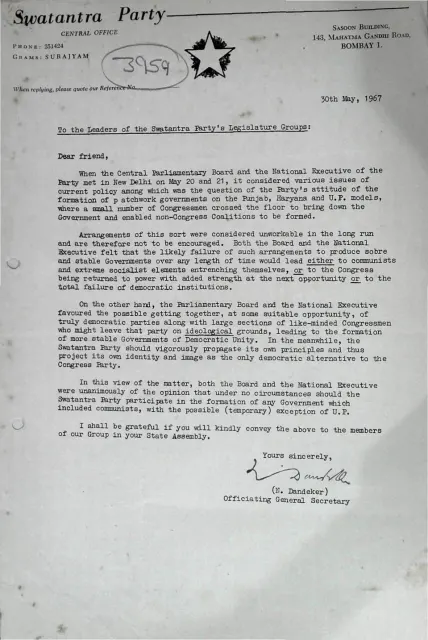
This letter, dated 30 May 1967 and signed by N. Dandekar as Officiating General Secretary of the Swatantra Party, conveys the Central Parliamentary Board and National Executive’s position on coalition governments in Punjab, Haryana, and Uttar Pradesh. It describes recent non-Congress governments formed after Congress legislators crossed the floor, but argues that such arrangements are unlikely to remain workable or stable.
The letter warns that unstable coalitions could strengthen communist and extreme socialist elements, return the Congress to power with greater strength, or damage democratic institutions. It therefore instructs Swatantra legislators not to participate in any government that includes communists, with a possible temporary exception for Uttar Pradesh. At the same time, it leaves open cooperation among genuinely democratic parties and like-minded Congress legislators who might leave Congress for ideological reasons, while urging Swatantra to present its own principles as the democratic alternative to the Congress.
Key points
- The Swatantra Party leadership reviewed the formation of non-Congress coalition governments in Punjab, Haryana, and Uttar Pradesh.
- It judged such coalitions unlikely to produce stable governments over the long term.
- The letter identifies communist and extreme socialist participation as a particular danger.
- It warns that coalition failure could return the Congress to power or weaken democratic institutions.
- Swatantra is encouraged to cooperate with genuinely democratic parties and ideologically compatible Congress legislators.
- The party is instructed to maintain a distinct identity and project itself as the democratic alternative to Congress.
- Swatantra legislators are told not to join governments containing communists, except possibly on a temporary basis in Uttar Pradesh.
Metadata and summary are AI-extracted from the source PDF and reviewed for editorial accuracy. The original work is available via the Read PDF tab above (where present); paragraph-level citation inside the PDF is deferred to a future engagement.