Summary
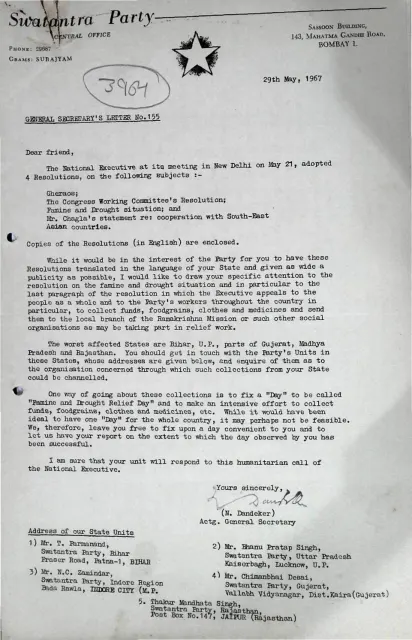
Dated 29 May 1967, this Swatantra Party circular from Acting General Secretary N. Dandekar transmits four resolutions adopted by the National Executive at its 21 May meeting in New Delhi. The first resolution condemns the growing use of “gherao” as an unlawful restraint on personal freedom, rights, and liberties, criticising State Governments for failing to protect affected citizens. It distinguishes gheraos from strikes and lock-outs, characterising them as a violent, anti-social weapon that threatens civil liberties, democracy, and the rule of law. The circular also asks State Units to organise local relief efforts for famine- and drought-affected regions by collecting funds, foodgrains, clothing, and medicines.
The resolution on the Congress Working Committee attacks expanded State control over the economy, arguing that Statist controls produce poor production and shortages and lead to further controls. It criticises nationalisation, State-sector expansion, and State trading as likely to increase political concentration, bureaucracy, corruption, and waste. The famine and drought resolution attributes suffering not only to failed monsoons but also to inadequate agricultural planning, irrigation, rural infrastructure, credit, and foodgrain policy, while calling for public relief and fundamental changes in government agricultural programmes. The final resolution welcomes M. C. Chagla’s proposal for regional economic cooperation among South-East Asian countries, presenting closer economic and cultural ties as a possible foundation for collective security.
Key points
- The circular encloses four resolutions adopted by the Swatantra Party National Executive on 21 May 1967.
- Gherao is condemned as an illegal assault on personal freedom and as distinct from legitimate strikes and lock-outs.
- The party argues that failure by governments to restrain gheraos threatens civil liberties, democracy, and the rule of law.
- The Congress Working Committee’s proposed expansion of economic controls is portrayed as a continuation of failed Statist policy.
- Nationalisation and expansion of the State sector are said to risk greater political concentration, bureaucracy, corruption, and waste.
- The famine and drought crisis is attributed to both poor rainfall and deficiencies in agricultural planning, irrigation, infrastructure, credit, and foodgrain policy.
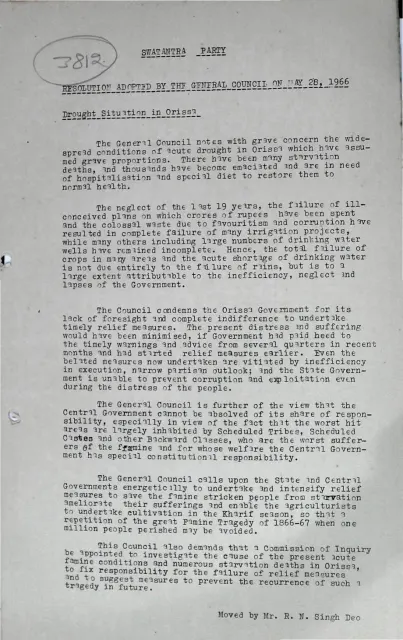
- Party units are urged to organise relief collections of funds, foodgrains, clothing, and medicines.
- Regional economic and cultural cooperation among South-East Asian countries is presented as a route toward mutual confidence and collective security.
Metadata and summary are AI-extracted from the source PDF and reviewed for editorial accuracy. The original work is available via the Read PDF tab above (where present); paragraph-level citation inside the PDF is deferred to a future engagement.