circular · manifesto
DRAFT MANIFESTO
(To Serve As A Basis For Discussion)
Swatantra Party · Bombay · 1966
15 pages
Summary
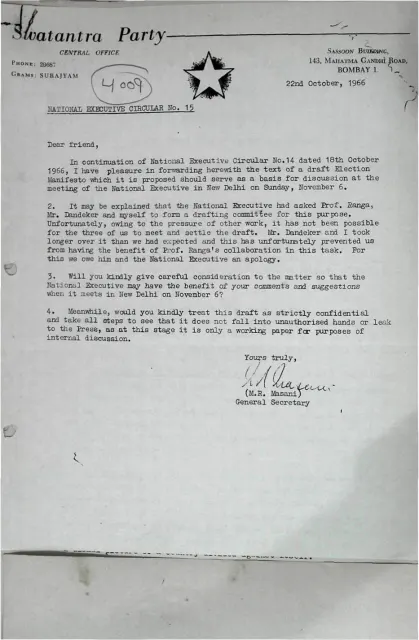
This internal Swatantra Party circular, dated 22 October 1966, forwards a draft election manifesto for discussion by the National Executive. The manifesto presents nearly two decades of Congress rule as having produced economic stagnation, high taxation, inflation, debt, constitutional erosion, weakened democratic institutions, foreign-policy failure, social division, and public corruption. It rejects dictatorship and both “pink” and “red” socialism, instead advocating “Democratic Individualism” as the basis for releasing individual enterprise within democratic constraints.
The proposed programme combines market-oriented economic reform with constitutional and social commitments. It calls for property-owning democracy, peasant proprietorship, freer agriculture, trade and industry, lower taxation, monetary stability, an end to the Permit-Quota-Licence Raj, abolition of the Planning Commission, opposition to monopolies and bank nationalisation, and greater reliance on competition and private investment. It also supports workers’ organisation and collective bargaining, subsidised food for the poor, and infrastructure development. The manifesto pledges restoration of Fundamental Rights and civil liberties, clean administration, an ombudsman, electoral reform, press and broadcasting autonomy, university autonomy, religious freedom, minority protection, scientific education, and a more openly anti-communist foreign and defence policy. Its concluding rationale joins individual self-interest to public service and invokes a Gandhian emphasis on Dharma.
Key points
- The circular transmits a confidential draft manifesto intended as a basis for National Executive discussion before the 1967 elections.
- The manifesto attributes India’s economic and political difficulties to two decades of Congress rule, inflationary finance, excessive controls, planning failures, and institutional erosion.
- It defines Swatantra’s alternative as Democratic Individualism rather than dictatorship or socialism, with individual enterprise serving the common good.
- Its economic programme prioritises peasant ownership, freer markets, lower taxes, monetary stability, competition, private investment, and dismantling the Permit-Quota-Licence Raj.
- It proposes restoring Fundamental Rights, ending the prolonged Emergency, strengthening clean administration and independent oversight, and reforming elections.
- It supports religious freedom, protections for minorities and backward classes, university autonomy, independent media, scientific education, and improved opportunities for agricultural labourers.
- Its foreign-policy position rejects abstract non-alignment after Chinese and Pakistani aggression, supports regional collective security, and takes a strongly anti-communist position.
Metadata and summary are AI-extracted from the source PDF and reviewed for editorial accuracy. The original work is available via the Read PDF tab above (where present); paragraph-level citation inside the PDF is deferred to a future engagement.