essay · position paper
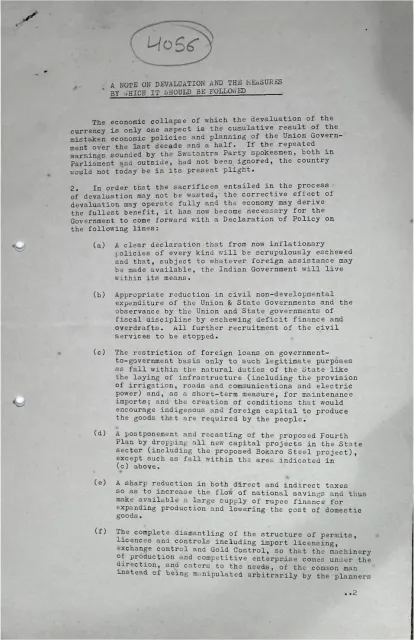
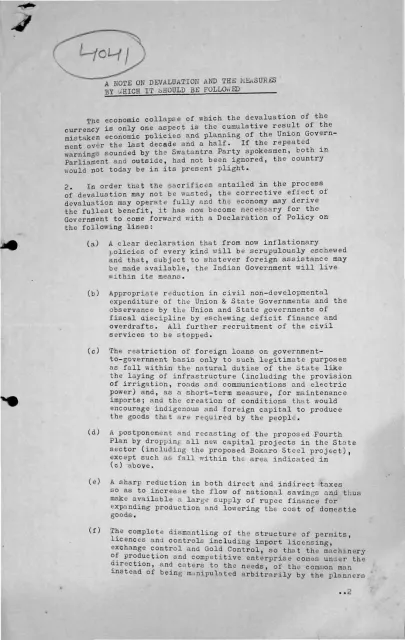
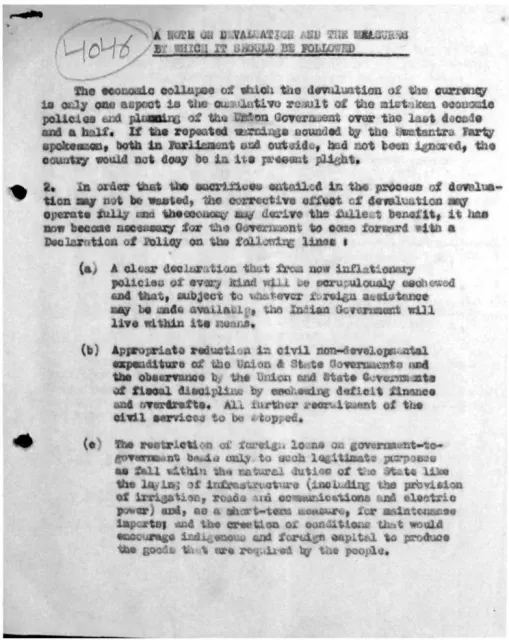
A NOTE ON DEVALUATION AND THE MEASURES BY WHICH IT SHOULD BE FOLLOWED
By Minoo Masani
1966
12 pages
Summary
Dated June 22, 1966, this policy note argues that India’s devaluation is the cumulative result of mistaken economic policies and planning decisions over the preceding decade. Signed by N. G. Ranga and M. R. Masani, it calls for an immediate declaration of policy to ensure that the sacrifices associated with devaluation are not wasted. The proposed direction includes ending inflationary policies, reducing civil and non-developmental expenditure, restricting government borrowing for non-essential purposes, and imposing fiscal discipline on Union and State governments.
The note advocates postponing and recasting the Fourth Plan, sharply reducing direct and indirect taxation to increase national savings, dismantling permits, licences, and exchange and gold controls, and exposing State enterprises to free competition rather than monopoly. It also recommends negotiations with foreign creditors, relief for industrial projects stranded mid-stream, adequate imported raw materials for non-traditional exporters, withdrawal of new export duties introduced with devaluation, and abolition of import duties and surcharges on raw materials, fuel, and spare parts. The discussion records exchanges with the Prime Minister and L. K. Jha, as well as references to B. R. Shenoy, Chester Bowles, L. Sawhny, and Rajaji.
Key points
- The note attributes the economic crisis and need for devaluation to a decade of mistaken economic policies and planning.
- It demands an immediate government declaration against inflation and for fiscal discipline.
- It recommends reducing non-developmental expenditure, limiting government borrowing, and postponing or recasting the Fourth Plan.
- It argues for lower taxation to expand national savings and rupee finance for productive investment.
- It calls for dismantling permits, licences, exchange controls, and gold controls, and for restoring competitive enterprise.
- It proposes negotiations with foreign creditors to reduce debt-servicing charges.
- It recommends transitional relief for stranded industrial projects and exporters who lost import entitlements.
- It urges withdrawal of devaluation-related export duties and abolition of duties on imported productive inputs.
Metadata and summary are AI-extracted from the source PDF and reviewed for editorial accuracy. The original work is available via the Read PDF tab above (where present); paragraph-level citation inside the PDF is deferred to a future engagement.