essay · position paper
A Note on Devaluation and the measures by which It should be followed
1966
2 pages
Summary
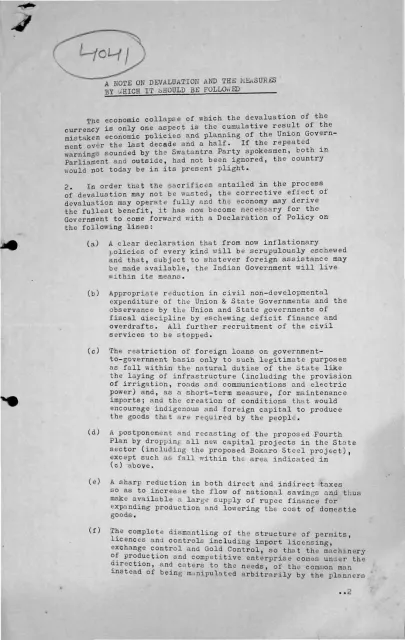
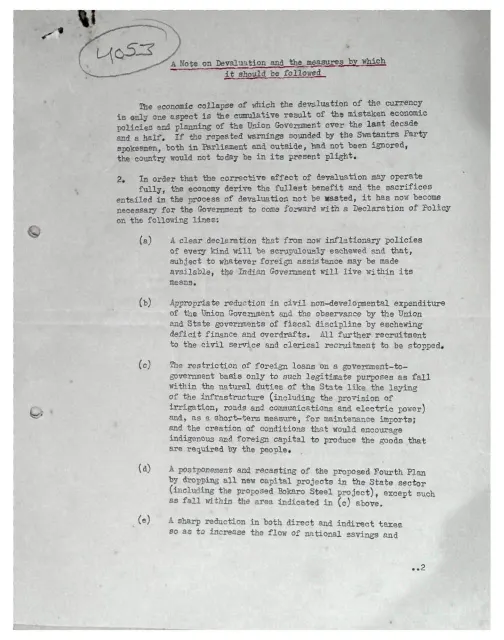
This two-page position paper, dated June 22, 1966, argues that the economic crisis accompanying India’s currency devaluation resulted from a decade and a half of mistaken Union Government policies and planning. It contends that devaluation will produce its intended corrective effects only if the government adopts fiscal discipline, curbs inflation, reduces non-developmental expenditure, abandons deficit financing and overdrafts, and postpones or recasts the proposed Fourth Plan, including most state-sector capital projects.
The paper also recommends limiting government-to-government foreign loans to infrastructure and essential maintenance imports, encouraging domestic and foreign capital to produce needed goods, dismantling permits, licences, import and exchange controls, and negotiating reduced foreign-debt servicing charges. Immediate relief measures include loans for stranded industrial projects, imported raw materials for exporters, withdrawal of new export duties, and abolition of import duties and related levies on raw materials, fuels, and spare parts. Its policy framework combines monetary and fiscal restraint with a substantial reduction of state controls and a stronger role for competitive enterprise.
Key points
- The paper attributes the economic crisis accompanying devaluation to longstanding Union Government economic policies and planning.
- It calls for a categorical end to inflationary policies and for the government to live within its means.
- It recommends reductions in civil non-developmental expenditure, fiscal discipline by Union and state governments, and an end to further civil-service and clerical recruitment.
- It proposes postponing and recasting the Fourth Plan by dropping most state-sector capital projects, with limited exceptions for essential infrastructure.
- It advocates dismantling permits, licences, import licensing, exchange control, and Gold Control to expand production and competition.
- It urges restrictions on foreign loans, renegotiation of foreign-debt servicing, and conditions favourable to indigenous and foreign capital.
- It proposes immediate support for stranded industrial projects and exporters, alongside the withdrawal or abolition of selected export and import duties.
Metadata and summary are AI-extracted from the source PDF and reviewed for editorial accuracy. The original work is available via the Read PDF tab above (where present); paragraph-level citation inside the PDF is deferred to a future engagement.