essay · report
VIEWS ON RAJAMANNAR COMMITTEE REPORT
2 pages
Summary
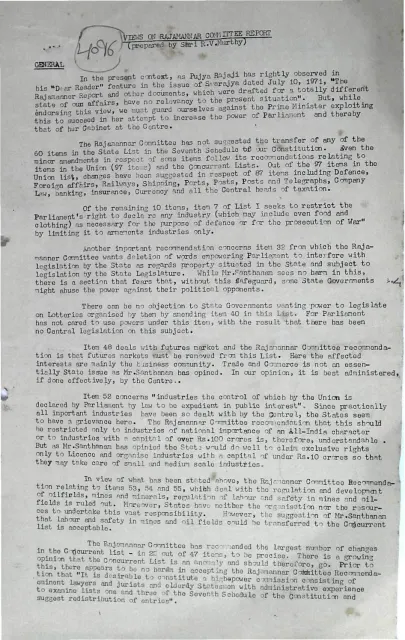
Prepared by Shri R. V. Murthy, this two-page report evaluates the Rajamannar Committee’s recommendations on the distribution of powers between the Union and the States. It argues that the Committee did not propose transferring items from the State List, but sought changes to most Union List entries and substantial revisions to the Concurrent List. The report supports greater State participation while warning against weakening Parliament or allowing State Governments to misuse expanded powers against political opponents.
The report endorses an Inter-State Council under Article 263, a statutory Planning Commission composed of independent experts rather than government members, and selected reforms concerning emergency provisions. It rejects changes to Article 31(2), supports retaining Union responsibility for major industries, futures markets, mines, and oilfields, and concludes that the acceptable recommendations would “rectify the distortion and reset the Constitution on its true basis.” The pages engage directly with C. Rajagopalachari (Rajaji), K. Santhanam, and Jawaharlal Nehru, while referring to the Rajamannar Committee itself as the central constitutional interlocutor.
Key points
- The report argues that the Rajamannar Committee did not recommend transferring any of the 60 items in the State List.
- It notes proposed changes to 87 of the 97 Union List items, including defence, foreign affairs, railways, posts, company law, banking, insurance, currency, and taxation.
- It supports an Inter-State Council under Article 263 but warns that it must not become merely a mouthpiece for the Prime Minister.
- It endorses a statutory Planning Commission composed solely of experts in economic, scientific, technical, and agricultural matters.
- It opposes amending Article 31(2) concerning presidential assent for State laws involving compulsory acquisition or requisition of private property.
- It supports retaining Union control over futures markets, major industries, and regulation of mines and oilfields, while accepting limited emergency-related reforms.
- It presents selective decentralisation as a means of restoring constitutional balance rather than as an across-the-board transfer of central powers.
Metadata and summary are AI-extracted from the source PDF and reviewed for editorial accuracy. The original work is available via the Read PDF tab above (where present); paragraph-level citation inside the PDF is deferred to a future engagement.