office record · working paper
Mrm Notes
Banaras
16 pages
Summary
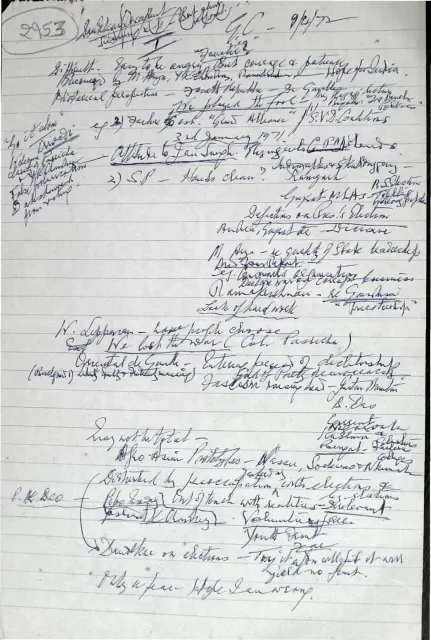
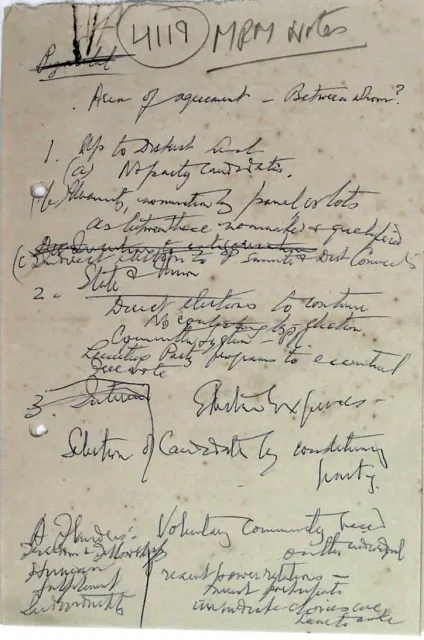
These untitled English-language working notes, headed in part “MRM notes,” are a loose set of political and economic arguments rather than a finished essay. The notes open with questions about the “aim of argument,” party contradictions, electoral procedure, the relation between elected representatives and voters, and the constitutional limits of government. They consider whether direct elections should be continued, how candidates might be selected, the role of parties, and whether constitutional safeguards can restrain political power.
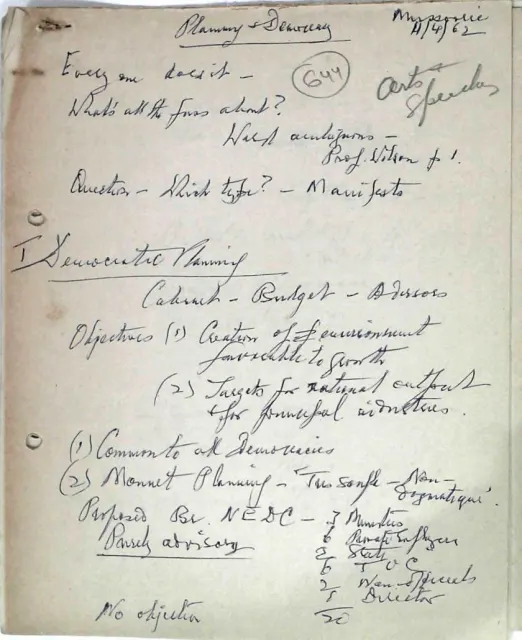
The later pages turn to planning, decentralisation, economic development, capital formation, industrialisation, and the financing of development. The writer questions centralised planning and large bureaucratic programmes, stresses the importance of private initiative and individual liberty, and asks how economic freedom can coexist with social and political objectives. Further notes address federalism, regional government, state intervention, public-sector expansion, agricultural and land questions, education, caste, women’s rights, and the practical organisation of a liberal political movement. The manuscript is fragmentary and heavily revised, with many passages too faint or overwritten to read confidently.
Key points
- Questions the internal contradictions of political parties and the institutional conditions required for effective democratic government.
- Discusses electoral systems, candidate selection, direct elections, party organisation, and the relationship between representatives and voters.
- Considers constitutional limits, judicial or institutional safeguards, and the distribution of authority between central and regional governments.
- Critiques centralised planning, bureaucratic expansion, and state-led industrialisation while emphasising private initiative and economic liberty.
- Connects capital formation and development finance to the problem of economic growth in poorer countries.
- Raises questions about decentralisation, federalism, agriculture, land, education, caste, women’s rights, and the practical construction of a liberal political movement.
- Presents an unfinished series of prompts and propositions rather than a continuous, fully argued text.
Metadata and summary are AI-extracted from the source PDF and reviewed for editorial accuracy. The original work is available via the Read PDF tab above (where present); paragraph-level citation inside the PDF is deferred to a future engagement.