essay
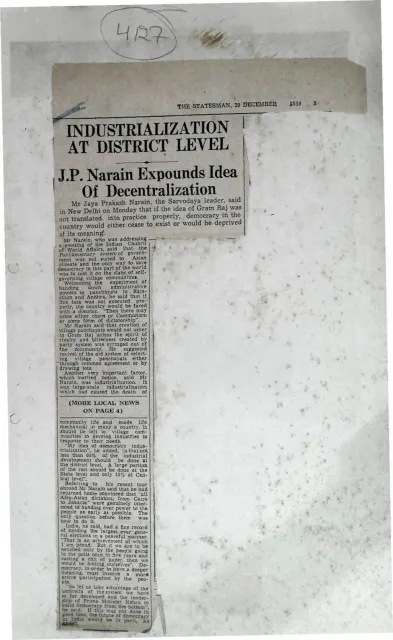
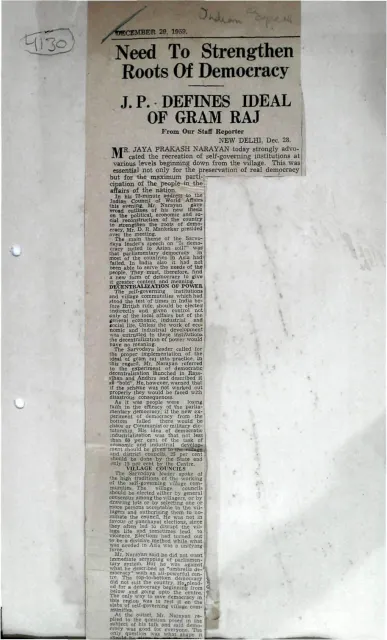
J.P. ADVOCATES FOUR-TIER STATE SET-UP
Village Community As The Foundation / INDIRECT SYSTEM OF VOTING URGED
HINDUSTAN TIMES · NEW DELHI · 1959
2 pages
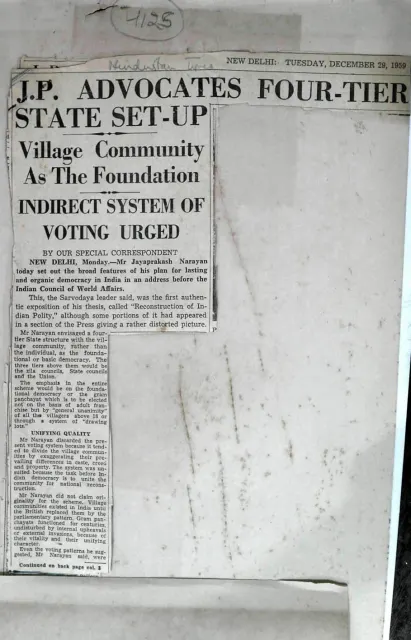
Summary
This two-page Hindustan Times report, dated December 29, 1959, presents Jayaprakash Narayan’s proposal for reconstructing Indian democracy around village communities rather than individuals as the foundation of the state. The proposed four-tier structure would run from village communities through gram panchayats and higher-level councils to the State and Union. Narayan advocates indirect elections and a gram panchayat chosen through “general unanimity,” rather than adult franchise or competitive party-based contests. He argues that this arrangement would express India’s own democratic traditions and help create a more organic, lasting democracy.
In the rendered pages, Narayan criticises parliamentary democracy as divisive, expensive, and poorly adapted to India’s rural social structure. He links party competition to caste, creed, property, and communal divisions, and warns that dissatisfaction with parliamentary government could produce either communist dictatorship or military rule. The report also records his view that village institutions historically functioned as living centres of Indian public life, and notes comparable experiments or ideals in Egypt, Pakistan, Indonesia, and Yugoslavia. The clipping ends while describing the practical establishment of gram panchayats in India’s villages.
Key points
- Jayaprakash Narayan proposes a four-tier state structure founded on village communities.
- The scheme would use indirect elections, with gram panchayats selected through “general unanimity” rather than adult franchise.
- Narayan presents village institutions as rooted in India’s historical democratic traditions.
- He argues that parliamentary competition deepens divisions based on caste, creed, property, and communal identity.
- The article reports his concern that parliamentary failure could lead to communist dictatorship or military rule.
- The proposal is framed as an attempt to build an organic and lasting democracy suited to Indian conditions.
- The report mentions analogous democratic experiments or models in Egypt, Pakistan, Indonesia, and Yugoslavia.
Metadata and summary are AI-extracted from the source PDF and reviewed for editorial accuracy. The original work is available via the Read PDF tab above (where present); paragraph-level citation inside the PDF is deferred to a future engagement.