constitution
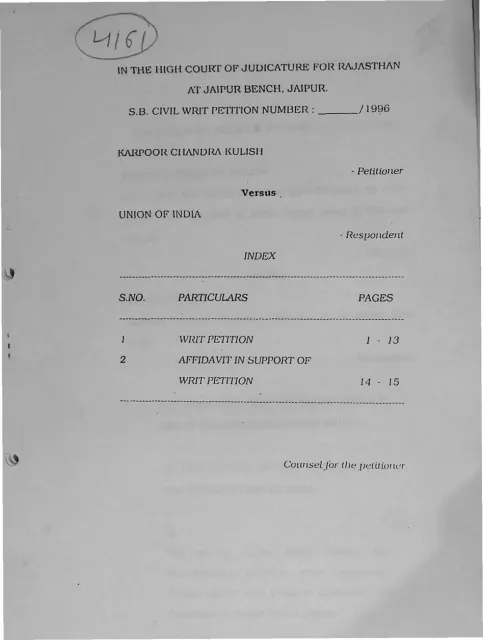
KARPOOR CHANDRA KULISH Versus UNION OF INDIA
Jaipur · 1996
17 pages
Summary
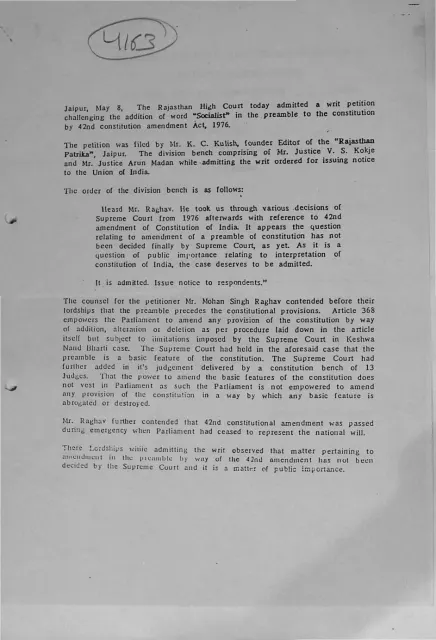
This 1996 civil writ petition before the Rajasthan High Court challenges the insertion of the word “Socialist” into the Preamble to the Constitution of India by the 42nd Constitutional Amendment Act, 1976. The petitioner, Kapoor Chandra Kulish, argues that the amendment was made during the Emergency, when opposition leaders were imprisoned and Parliament no longer represented the national will. He maintains that “Socialist” is undefined, politically appropriated, and inconsistent with the Constitution’s commitments to individual dignity, liberty, equality, natural rights, and democratic government.
The petition invokes constitutionalism, judicial review, and the distinction between Parliament’s limited amending power and the Constituent Assembly’s original constitution-making power. It presents judicial independence and the rule of law as safeguards against executive abuse, drawing on Archibald Cox and Thomas Jefferson. The petition also contrasts its understanding of Indian constitutional democracy with Marxist socialism, discusses Nehru’s association with a “Socialistic Pattern of Society,” and argues that post-1991 economic reforms and the collapse or reform of socialist states further undermine the word’s continued inclusion. It ultimately asks the High Court to strike “Socialist” from the Preamble. The accompanying affidavit verifies the petitioner’s identity and the truth of the petition’s contents.
Key points
- The petition seeks removal of the word “Socialist” from the Preamble to the Constitution of India.
- It argues that the word was inserted during the 1975–77 Emergency, when political opposition was suppressed.
- The petitioner says “Socialism” is undefined and can signify doctrines incompatible with constitutional liberty and individual rights.
- The petition presents judicial review and an independent judiciary as protections against arbitrary executive and legislative power.
- It distinguishes Parliament’s amending authority under Article 368 from the Constituent Assembly’s constitution-making power.
- It argues that the original Preamble’s commitments to justice, liberty, equality, and fraternity already provide the relevant constitutional aims.
- The petition cites economic reforms after 1991 and changes in socialist countries as reasons the amendment is obsolete or unwarranted.
- The final relief sought is a writ, order, or direction striking “Socialist” from the Preamble.
Metadata and summary are AI-extracted from the source PDF and reviewed for editorial accuracy. The original work is available via the Read PDF tab above (where present); paragraph-level citation inside the PDF is deferred to a future engagement.