Summary
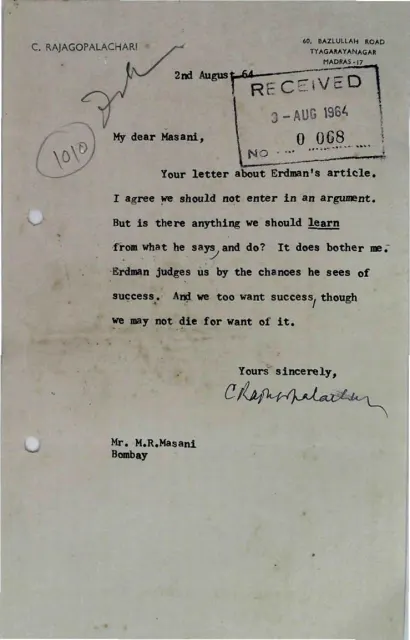
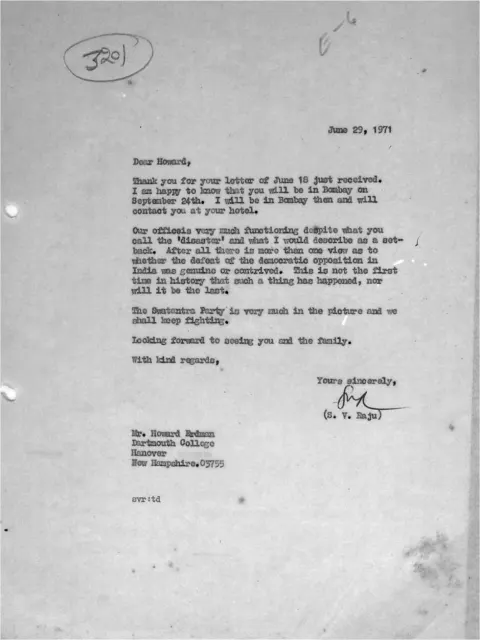
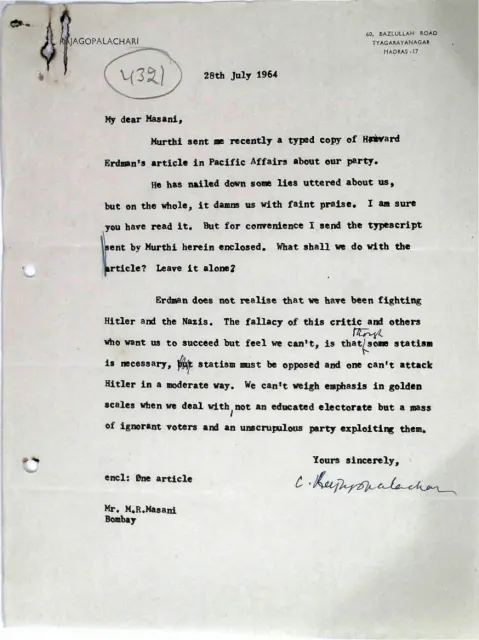
The document opens with C. Rajagopalachari’s letter of 28 July 1964 to M. R. Masani, enclosing Howard L. Erdman’s article on the Swatantra Party. Rajagopalachari says that Erdman has recorded some of the party’s alleged falsehoods but has, on balance, given it faint praise. He objects particularly to the criticism that statism must be opposed only moderately, arguing that the party cannot attack Hitler “in a moderate way” while confronting an uneducated electorate and an unscrupulous political machine.
The enclosed article, “India’s Swatantra Party,” examines the party’s origins, leadership, doctrine, social composition, electoral performance, and political dilemmas after the 1962 general election. It presents Swatantra as a secular, constitutionalist, anti-statist, economically liberal alternative to Congress socialism, while stressing the tensions created by its dependence on princes, landlords, regional notables, and conservative alliances. The article’s central concern is whether a party committed to individual initiative, property rights, limited government, and judicial review can also become a genuinely progressive liberal movement. Its conclusion is qualified: Swatantra is neither simply communal nor fascist, but its organizational weakness, elite social base, accommodation with illiberal forces, and silence on traditionalism threaten its liberal potential.
Key points
- Rajagopalachari’s covering letter forwards Erdman’s assessment of the Swatantra Party to M. R. Masani and asks whether the article should be left unanswered.
- The article describes Swatantra’s strong showing in the 1962 elections, including about eight per cent of the popular vote and a major opposition presence in several states.
- Its national leadership is portrayed as diverse but broadly anti-communist, anti-statist, constitutionalist, and detached from both militant Hindu nationalism and princely-landlord traditionalism.
- The party’s twenty-one fundamental principles emphasize equality, individual initiative, enterprise, property rights, limited state intervention, fiscal responsibility, and judicial review.
- The article distinguishes Swatantra’s classical liberal doctrine from Gandhi’s economics, while noting a limited use of Gandhian trusteeship and decentralization.
- Swatantra’s positions on English, China, Kashmir, Goa, regional-language movements, and separatist agitations reveal a leadership often willing to adopt unpopular or politically difficult positions.
- The party’s reliance on princes, landlords, and local notables, and its alliances with parties such as Jan Sangh and the Hindu Mahasabha, complicate its claim to be a progressive liberal force.
- The article concludes that Swatantra is secular and constitutionalist but risks becoming a truncated liberalism focused almost exclusively on opposing statism.
Metadata and summary are AI-extracted from the source PDF and reviewed for editorial accuracy. The original work is available via the Read PDF tab above (where present); paragraph-level citation inside the PDF is deferred to a future engagement.