Summary
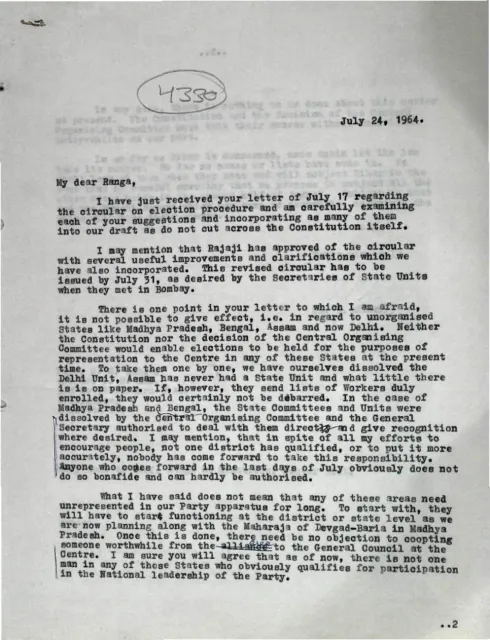
In this two-page letter dated July 24, 1964, M. R. Masani replies to Prof. N. G. Ranga about a circular on election procedure. He says he is incorporating Ranga’s suggestions where they do not conflict with the Constitution, and notes that Rajaji has approved a revised circular with additional improvements and clarifications. The circular was expected to be issued by July 31 following a meeting of state secretaries in Bombay.
Masani addresses the organisational difficulties of holding elections in states without functioning or recognised party units, particularly Madhya Pradesh, Bengal, Assam, and Delhi. He argues that neither the Constitution nor the Central Organising Committee’s decision could presently enable elections for representation from those states, and that existing arrangements should proceed without further intervention. He proposes rebuilding party organisation at district or state level, including planning with the Maharaja of Devgad-Baria in Madhya Pradesh, while allowing worthwhile individuals to be co-opted into the General Council. He adds that Bihar will be scrutinised under the same rules as other state units, alongside the forthcoming Munshi Report.
Key points
- Masani responds to Ranga’s suggestions on a circular governing election procedure.
- He accepts proposed changes when they do not cut across the Constitution.
- Rajaji has approved the revised circular, which was to be issued by July 31, 1964.
- Masani says elections cannot presently be organised in Madhya Pradesh, Bengal, Assam, or Delhi because functioning state units or qualified delegates are absent.
- He describes the dissolution or paper-only status of several state organisations and the lack of district-level participation.
- He proposes rebuilding party organisation at district or state level and co-opting worthwhile individuals into the General Council.
- Bihar is to be subjected to careful scrutiny under the rules applied to other state units, with the Munshi Report also taken into account.
Metadata and summary are AI-extracted from the source PDF and reviewed for editorial accuracy. The original work is available via the Read PDF tab above (where present); paragraph-level citation inside the PDF is deferred to a future engagement.