pamphlet
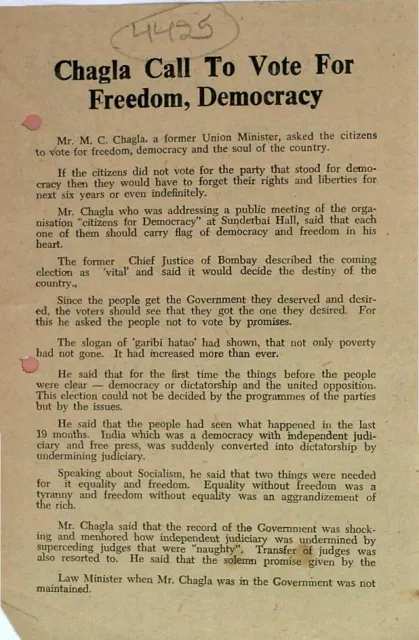
Chagla Call To Vote For Freedom, Democracy
States' People Press, Fort, Bombay—400 001. · Bombay
2 pages
Summary
This two-page English political leaflet reports M. C. Chagla’s address to a public meeting of the Citizens for Democracy at Sunderbai Hall. Chagla presents the coming election as a decisive choice between democracy and dictatorship, urging voters to judge parties by their records and issues rather than by electoral promises. He argues that the slogan “garibi hatao” had not eliminated poverty and that poverty had instead increased.
The leaflet focuses on the erosion of civil liberties during the Emergency. Chagla alleges that an independent judiciary had been undermined, dissent and criticism suppressed, newspapers censored, and citizens arrested without trial. He links socialism to the need for both equality and freedom, warning that equality without freedom becomes tyranny. The appeal concludes by asking voters to support the party that will guarantee democratic rights, an independent judiciary, and freedom of the press.
Key points
- M. C. Chagla urges citizens to vote for freedom and democracy in the coming election.
- The election is described as a choice between democracy and dictatorship, not merely between party programmes.
- The leaflet claims that poverty had increased despite the “garibi hatao” slogan.
- Chagla argues that the Emergency damaged judicial independence and enabled detention without trial.
- The text alleges that dissent, criticism, letters to newspapers, and editorial policies were subject to censorship.
- Socialism is presented as requiring both equality and freedom; equality without freedom is characterised as tyranny.
- Voters are asked to choose the party that will protect civil liberties, an independent judiciary, and press freedom.
Metadata and summary are AI-extracted from the source PDF and reviewed for editorial accuracy. The original work is available via the Read PDF tab above (where present); paragraph-level citation inside the PDF is deferred to a future engagement.