Summary
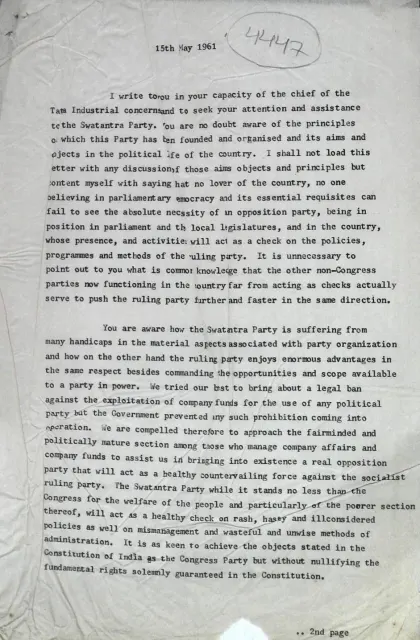
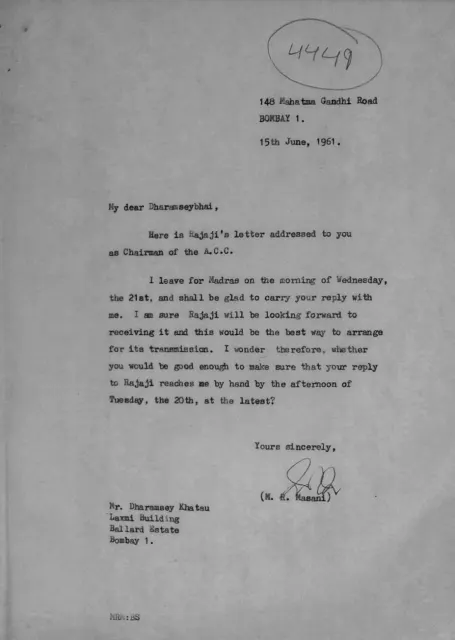
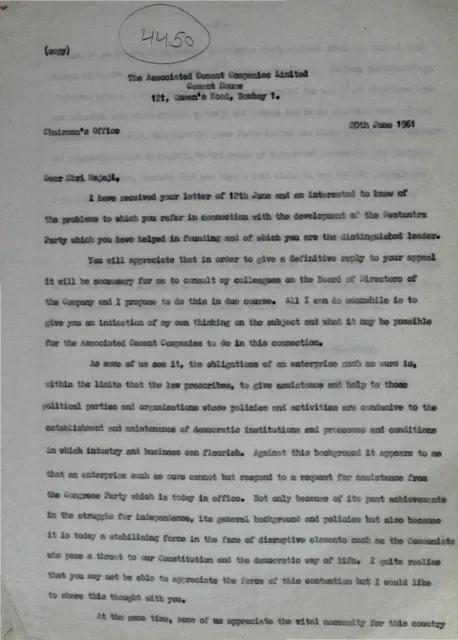
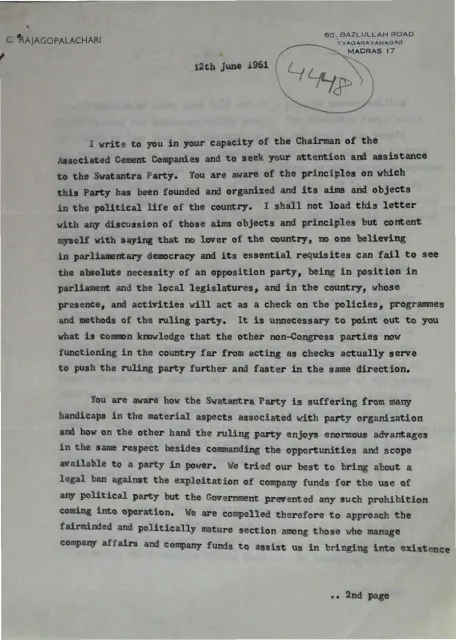
In this untitled letter dated 12 June 1961, C. Rajagopalachari appeals to Dharamsey M. Khatau, chairman of the Associated Cement Companies, for financial assistance to the Swatantra Party. Rajagopalachari presents a strong opposition party as essential to parliamentary democracy: it should check the ruling party’s policies, programmes, and methods in Parliament, the legislatures, and the country. He argues that the existing non-Congress parties are ineffective checks and instead push the ruling party further in the same direction.
Rajagopalachari explains that the Swatantra Party faces serious organisational and financial disadvantages while the ruling party enjoys the advantages of incumbency. He asks business leaders to support the creation of a genuine countervailing force against the socialist ruling party, while insisting that Swatantra seeks the welfare of the people, including poorer sections, and aims to achieve the Constitution’s objectives without nullifying fundamental rights. The letter closes with a personal appeal: despite his inclination toward retirement and a nonpolitical life, Rajagopalachari says he has taken up the cause of opposition politics in the interests of parliamentary democracy and good government.
Key points
- Rajagopalachari argues that parliamentary democracy requires an effective opposition party capable of checking the ruling party.
- He criticises existing non-Congress parties for failing to act as meaningful checks on the government’s direction.
- The Swatantra Party is described as disadvantaged in organisation and funding compared with the ruling party.
- The letter seeks assistance from company leaders and business interests to establish Swatantra as a genuine opposition.
- Rajagopalachari presents Swatantra as committed to public welfare, including the interests of poorer sections.
- He links the party’s programme to the Constitution’s objectives and the protection of fundamental rights.
- The appeal is framed as a defence of good government and parliamentary democracy rather than a merely partisan request.
Metadata and summary are AI-extracted from the source PDF and reviewed for editorial accuracy. The original work is available via the Read PDF tab above (where present); paragraph-level citation inside the PDF is deferred to a future engagement.