letter
Letter to C Rajagopalachari
Rajkot · 1968
3 pages
Summary
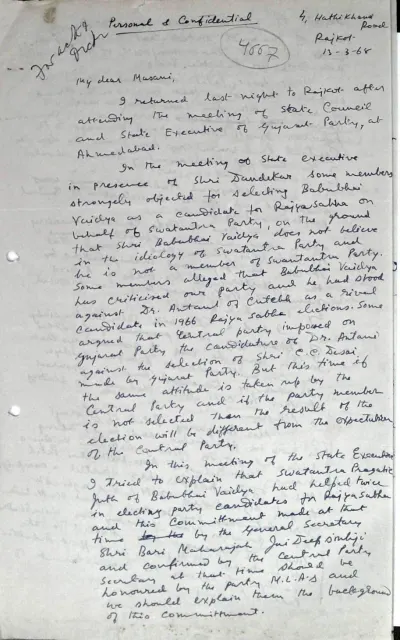
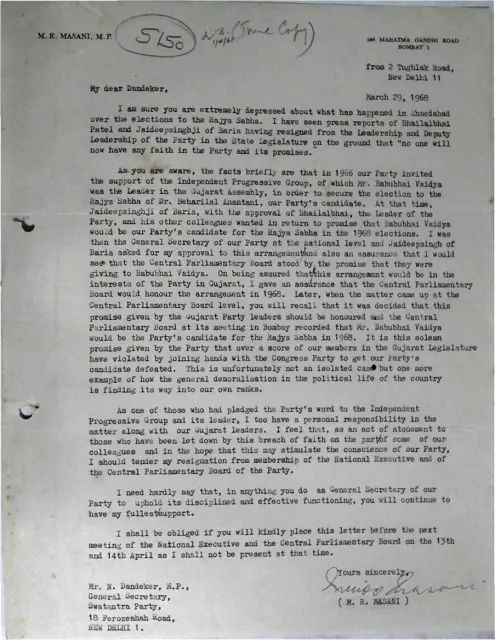
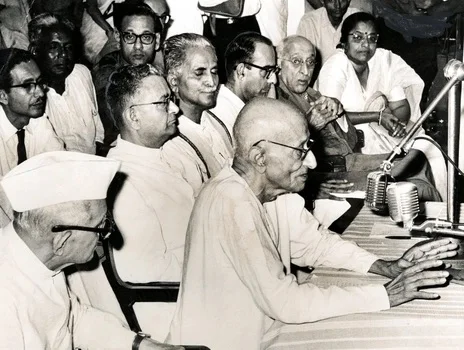
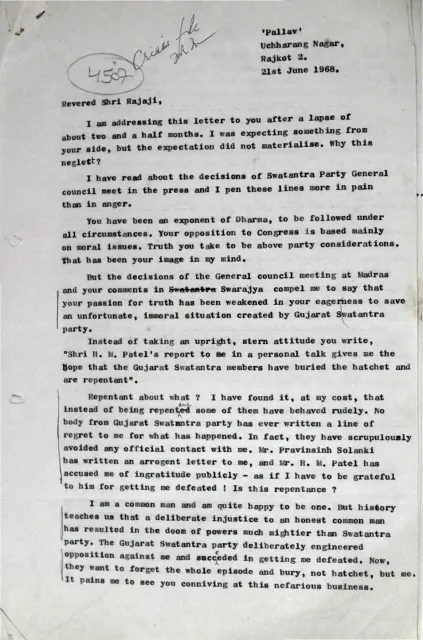
In this three-page letter dated 21 June 1968, Babulal P. Vaidya writes to C. Rajagopalachari (“Rajaji”) in distress over the Gujarat Swatantra Party’s role in defeating him in a Rajya Sabha election. Vaidya contrasts Rajagopalachari’s public image as an exponent of Dharma and truth with what he sees as Rajaji’s willingness to excuse an “unfortunate, immoral situation” created by Gujarat Swatantra leaders. He rejects their supposed repentance, citing the absence of regret, hostile correspondence from Pravinsinh Solanki, and H. M. Patel’s public accusation of ingratitude.
Vaidya argues that Gujarat Swatantrites conspired against him, then secured Rajagopalachari’s endorsement through disciplinary action that he calls a “sheer eyewash.” He links the dispute to an unconditional pledge made by Gujarat leaders in 1966, which helped Beharilal Antani win a seat in the Council of State, and invokes Mahatma Gandhi’s fasting against Darbar Virawala as an example of refusing to tolerate a broken promise. The letter closes with an appeal to Rajagopalachari to uphold moral values and demand genuine repentance from the Gujarat party leaders.
Key points
- Vaidya expresses pain and disappointment at Rajagopalachari’s apparent support for Gujarat Swatantra leaders.
- He argues that his opposition to the Congress and Rajagopalachari’s political conduct should both be governed by moral principles.
- He alleges that Gujarat Swatantrites deliberately engineered his defeat in a Rajya Sabha election.
- He dismisses the party’s disciplinary action and claims that the alleged culprits showed no genuine repentance.
- He recalls a 1966 pledge by Gujarat Swatantra leaders that enabled Beharilal Antani’s election to the Council of State.
- He uses Mahatma Gandhi’s response to Darbar Virawala as a precedent for insisting that broken promises must have consequences.
- He asks Rajagopalachari to intervene and require the Gujarat party leaders to demonstrate genuine repentance.
Metadata and summary are AI-extracted from the source PDF and reviewed for editorial accuracy. The original work is available via the Read PDF tab above (where present); paragraph-level citation inside the PDF is deferred to a future engagement.