
Summary
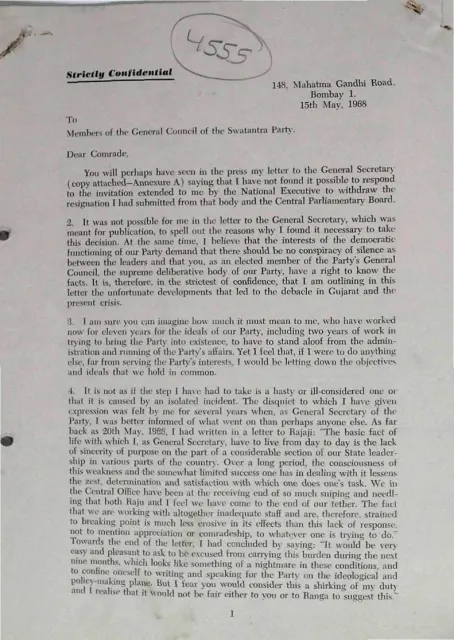
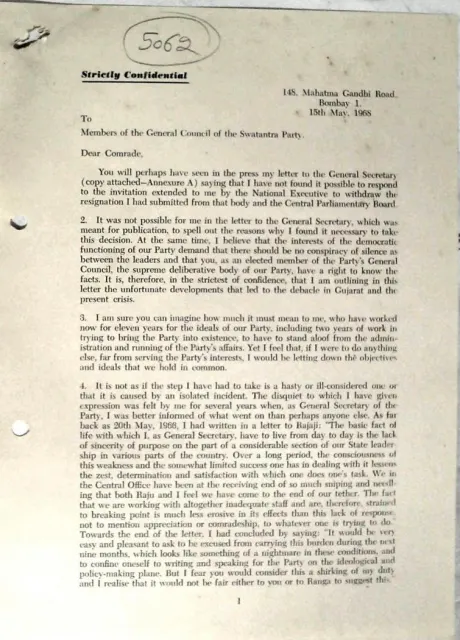
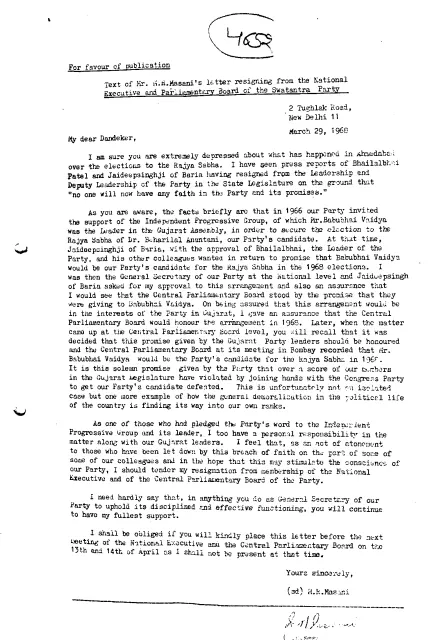
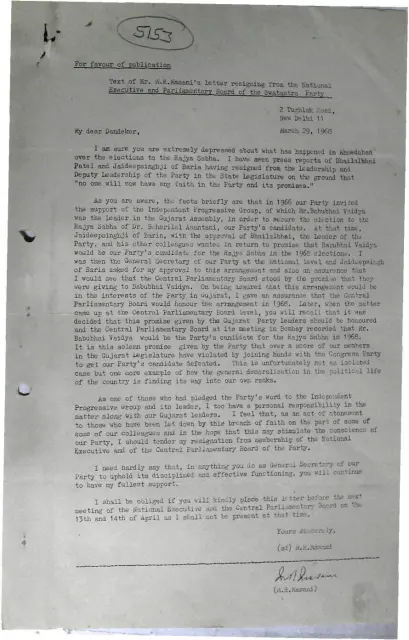
In this letter of 15 May 1968 to members of the Swatantra Party’s General Council, M. R. Masani explains why he has refused to withdraw his resignation from the National Executive and Central Parliamentary Board. He presents the Gujarat episode as the culmination of years of organisational weakness: inadequate leadership, broken commitments, factional manoeuvring, insufficient discipline, and a damaging reluctance to acknowledge responsibility. The immediate dispute concerned the Party’s promise to support Babubhai Vaidya for the Rajya Sabha, followed by the nomination and support of U. N. Mahida instead. Masani argues that the Gujarat leadership and the National Executive failed both ethically and politically, thereby undermining the Party’s credibility with voters.
Masani also frames the dispute as a constitutional and organisational question. He objects to the National Executive allowing a State unit to adopt a position different from that of the Party as a whole, particularly on the Kutch Award, and argues that the Party’s 21 Principles do not authorise State units to depart from national policy. He says his resignation is intended both as an ethical response to those wronged and as an attempt to stimulate the Party’s conscience. The attached annexures reproduce related correspondence, including his resignation position, N. Dandekar’s account of the Gujarat controversy, and an exchange concerning the proposed removal of Masani as General Secretary. Across the dossier, Masani proposes that he continue contributing through “constructive work,” including training younger workers in liberal democracy, while remaining willing to serve the Party again if it restores ethical, disciplined, and truthful functioning.
Key points
- Masani refuses to withdraw his resignation from the Swatantra Party’s National Executive and Central Parliamentary Board.
- He attributes the Gujarat crisis to prolonged administrative weakness, inadequate staffing, factionalism, and failures of leadership.
- The central incident is the failure to honour the Party’s commitment to support Babubhai Vaidya for the Rajya Sabha.
- Masani criticises the National Executive for imposing limited discipline on Gujarat rebels while failing to address senior leaders and parliamentarians who opposed the Party’s candidate.
- He argues that the Party’s 21 Principles apply to individual members and cannot justify divergent policies by State units.
- He presents resignation as an ethical protest and an effort to restore the Party’s credibility and stimulate its conscience.
- He proposes devoting himself to training young people in liberal democracy and other forms of constructive work outside the National Executive.
- He closes by linking legitimate political leadership to voluntary acceptance of a leader’s policies rather than pressure, mechanical majorities, or expediency.
Metadata and summary are AI-extracted from the source PDF and reviewed for editorial accuracy. The original work is available via the Read PDF tab above (where present); paragraph-level citation inside the PDF is deferred to a future engagement.
People in this work
Related across the archive
 Primary workLetter to Member of General Council of the Swatantra party
 Primary workFor favour of publication
 Primary workText of Mr. M.R. Masani's letter resigning from the National Executive and Parliamentary Board of the Swatantra Party
 ExcerptTowards Party-less Democracy
 ExcerptThe Party or the People?