Summary
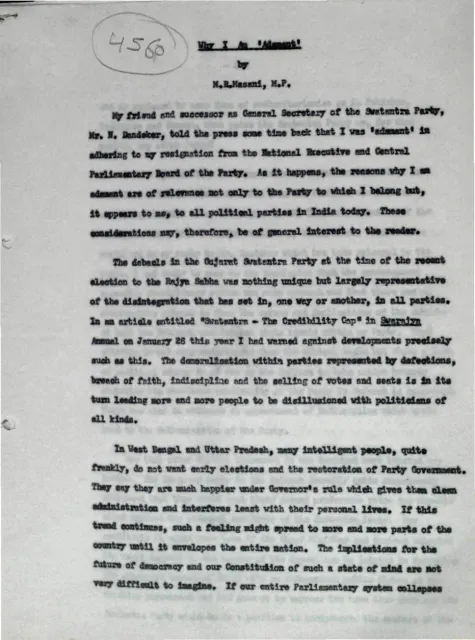
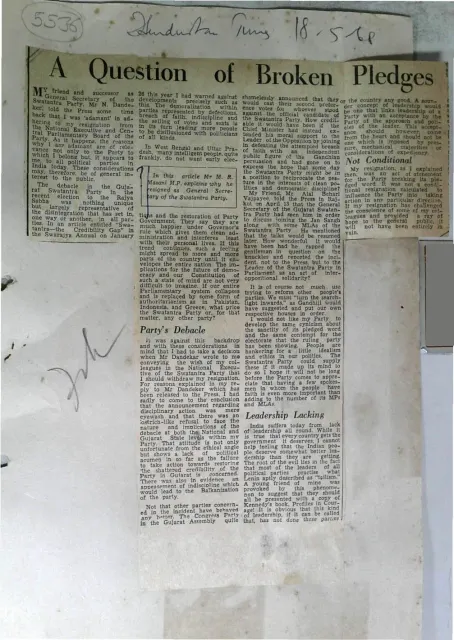
In this short pamphlet, M. R. Masani explains why he has remained “adamant” in adhering to his resignation from the Swatantra Party’s National Executive and Central Parliamentary Board. He presents the immediate dispute in Gujarat as part of a wider deterioration of political standards: defections, breaches of faith, indiscipline, and the buying and selling of votes and seats. He argues that the failure to confront such conduct damages the credibility of political parties and risks deepening public disillusionment with parliamentary democracy.
Masani also criticizes other parties, including the Congress Party’s decision to cast second-preference votes against the Swatantra candidate, while distinguishing political solidarity from opportunistic bargaining. He calls for “clean politics and democratic discipline,” leadership grounded in public trust rather than pressure or mechanical majorities, and fidelity to pledged words. His resignation, he concludes, was an act of atonement rather than a conditional tactic intended to force the party into a particular course; if it has challenged the conscience of colleagues and renewed public hope, it has not been in vain.
Key points
- Masani frames his resignation from the Swatantra Party as a principled response to party indiscipline and a breach of its pledged word.
- The Gujarat party dispute is presented as symptomatic of broader disintegration across Indian political parties.
- Defections, vote-buying, seat-buying, and failures to discipline misconduct are said to erode public confidence in politics.
- Masani warns that growing disenchantment with parliamentary politics could encourage authoritarian alternatives.
- He criticizes the Congress Party’s electoral conduct while also insisting that other parties must put their own houses in order.
- The pamphlet advocates clean politics, democratic discipline, ethical leadership, and acceptance of party policies from conviction rather than coercion.
- Masani places hope in the continued efficacy of democratic processes and institutions despite contemporary political failures.
Metadata and summary are AI-extracted from the source PDF and reviewed for editorial accuracy. The original work is available via the Read PDF tab above (where present); paragraph-level citation inside the PDF is deferred to a future engagement.