correspondence
Letter to Mr Minoo Masani
By K. M. Munshi
Bharatiya Vidya Bhavan, Chaupatty Road, Bombay 7. · Bombay · 1968
2 pages
Summary
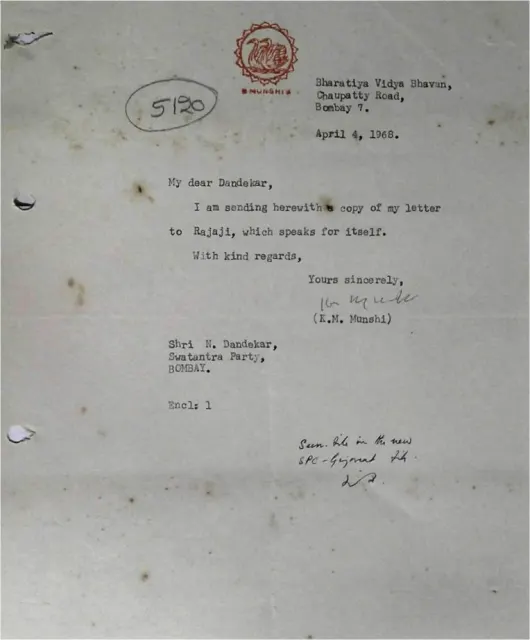
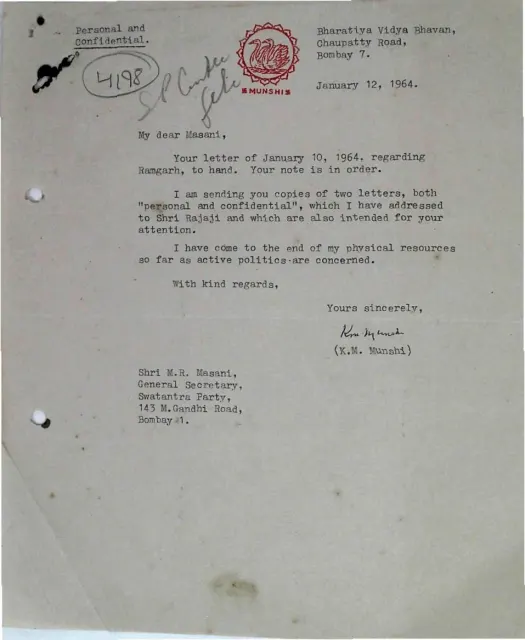
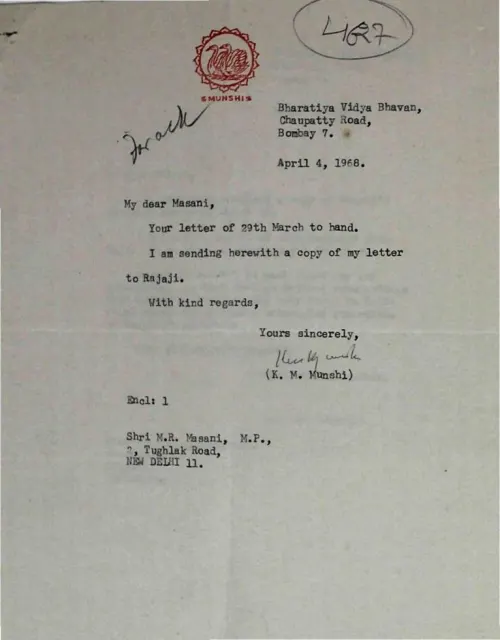
This two-page correspondence bundle contains two letters by K. M. Munshi, both dated April 4, 1968, written from Bharatiya Vidya Bhavan in Bombay. In the first, Munshi acknowledges M. R. Masani’s letter of March 29 and says he is forwarding a copy of his own letter to C. Rajagopalachari. In the second, addressed to Rajagopalachari, Munshi refers to Masani’s circular letter and reports on events involving Rajaji, stating that the rebels should be expelled.
Munshi presents the political disagreement as a matter of principle rather than temporary advantage. He argues that the party may be few in number but must stand by its principles, and claims that foreign writers have recognized the Swatantra Party as the only Indian party standing for definite principles regardless of temporary advantage. The pages therefore document a brief exchange within the Swatantra Party’s liberal political network, but do not provide the underlying circular letter, Munshi’s enclosed letter to Rajagopalachari, or the full report to which he refers.
Key points
- Munshi writes two letters dated April 4, 1968, from Bharatiya Vidya Bhavan, Bombay.
- The first letter to M. R. Masani acknowledges Masani’s March 29 letter and forwards Munshi’s letter to Rajagopalachari.
- The second letter to C. Rajagopalachari refers to Masani’s circular letter of March 29.
- Munshi says that, in his view, the rebels should be expelled.
- He insists that political actors must stand by their principles even when they are few.
- He presents the Swatantra Party as uniquely committed to definite principles regardless of temporary advantage.
Metadata and summary are AI-extracted from the source PDF and reviewed for editorial accuracy. The original work is available via the Read PDF tab above (where present); paragraph-level citation inside the PDF is deferred to a future engagement.