essay
Sandesh
SANDESH · AHMEDABAD · 1968
2 pages

Summary
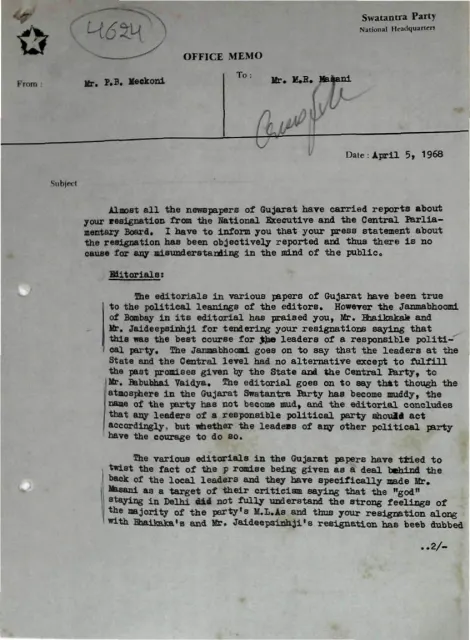
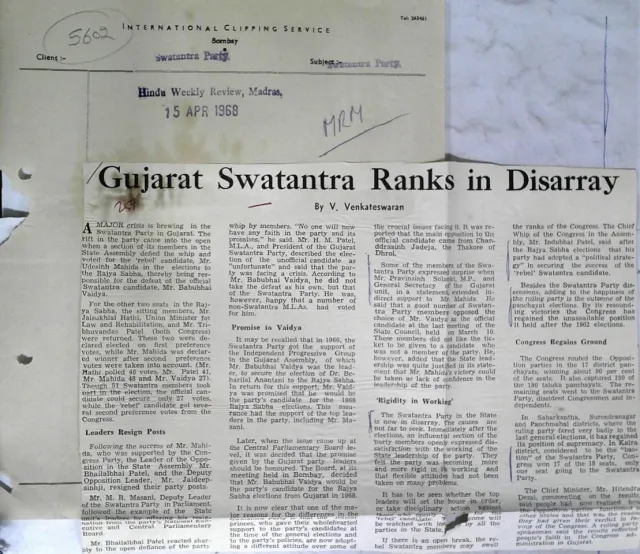
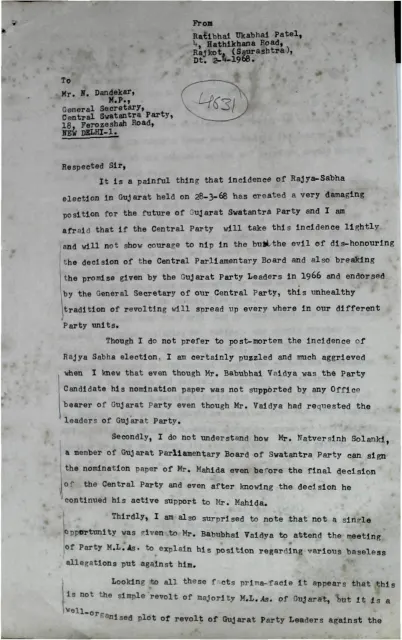
This two-page English press report, published in Sandesh in Ahmedabad on 29 March 1968, describes an internal Swatantra Party dispute following an election involving Gujarat legislators. Bhailalbhai Patel says that Mr. Mahida received 40 first-preference votes, suggesting that 38 Swatantra Party MLAs rebelled against the party’s official candidate, Mr. Vaidya. Patel also says he resigned as opposition leader on 28 March and criticizes the party’s handling of a promise made to Vaidya with the consent of 26 MLAs and confirmation by the Central Party.
H. M. Patel defends fulfilling the earlier promise, arguing that the party’s office-bearers were bound by commitments made when Vaidya’s group helped elect two members to the Rajya Sabha. He says legislators who signed Mahida’s nomination papers violated party discipline, although he does not specify what action will be taken. On the second page, Jaideepsinhji describes the result as evidence of declining confidence in the leadership, Pravingsinhji Solanki calls for a review, and Piloo Mody characterizes the matter as complicated while acknowledging that Mahida appeared to have majority support. The report closes by saying that the party is in crisis and must behave in a way that restores public trust.
Key points
- The report attributes Mahida’s 40 first-preference votes to a revolt by 38 Swatantra Party MLAs.
- Bhailalbhai Patel is reported to have resigned as opposition leader on 28 March 1968.
- The dispute centers on an earlier promise made to Mr. Vaidya with the consent of 26 MLAs and confirmation by the Central Party.
- H. M. Patel argues that later party members remain bound by commitments made before they joined.
- Signatories to Mahida’s nomination papers are accused of breaching party discipline, though disciplinary action is undecided.
- Several party figures interpret the result as evidence of weakened confidence in the leadership and call for a review.
- Piloo Mody says the majority appears to support Mahida and that the party crisis requires conduct capable of restoring public trust.
Metadata and summary are AI-extracted from the source PDF and reviewed for editorial accuracy. The original work is available via the Read PDF tab above (where present); paragraph-level citation inside the PDF is deferred to a future engagement.