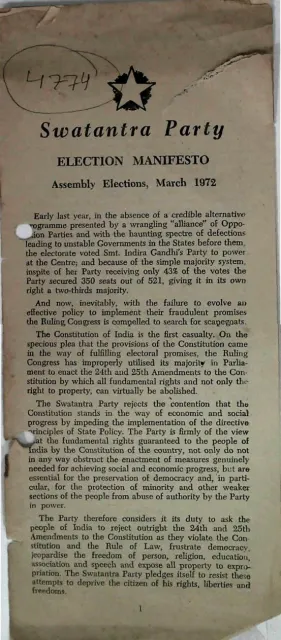
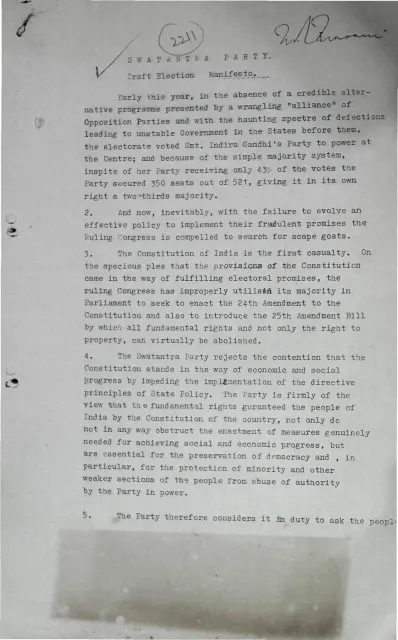
pamphlet · manifesto
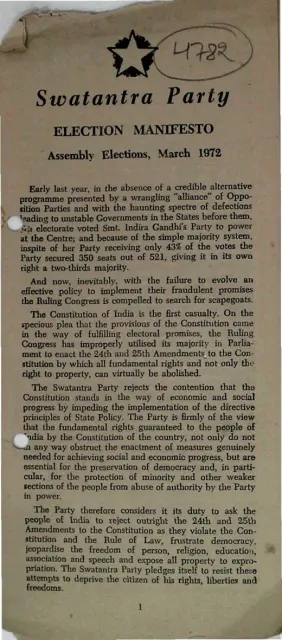
ELECTION MANIFESTO
Assembly Elections, March 1972
Published by S. V. Raju, Executive Secretary, Swatantra Party, National Headquarters, 143 Mahatma Gandhi Road, Bombay 1 and printed by him at Inland Printers, 55 Gamdevi Road, Bombay 7. · Bombay · 1972
6 pages
Summary
The Swatantra Party’s 1972 Assembly Election Manifesto presents the party as an alternative to Congress centralisation, statism, and what it describes as the erosion of constitutional protections. It condemns the 24th and 25th Amendments for weakening fundamental rights, property rights, freedom of speech, and the Rule of Law, and links these changes to the danger of one-party, one-leader government. The manifesto also defends an independent press, criticising state control over broadcasting and proposed ideological screening of imported publications.
On economic policy, the manifesto attributes stagnation, inflation, unemployment, and worsening conditions among poorer Indians to excessive state control, an overextended public sector, and indiscriminate nationalisation. It advocates a mixed economy in which government supplies infrastructure, regulates and assists industry, supports research, and helps farmers obtain the benefits of the Green Revolution, while private enterprise remains autonomous. Its numbered programme supports secure tenancy and fair rents, higher agricultural output, competitive industry with labour and consumer safeguards, collective bargaining, limited state enterprise, protection for small producers, moderate taxation, and cleaner administration through institutions such as the Lokpal and Lokayukta. The final appeal combines individual liberty and restrained government with a call to restore the “Gandhian principle” of giving first priority to Dharma.
Key points
- The manifesto frames the Swatantra Party as a credible alternative to Congress rule and criticises the concentration of political power.
- It defends fundamental rights, property rights, freedom of speech and expression, minority protection, and the Rule of Law.
- It opposes state domination of the press, broadcasting, trade, and manufacturing, while retaining important public responsibilities for infrastructure and natural-resource conservation.
- It attributes inflation, unemployment, economic stagnation, and worsening poverty to statist policies, public-sector overreach, and excessive regulation.
- It proposes agricultural measures including secure tenure, fair rents, minimum wages for landless labourers, crop and cattle insurance, credit, inputs, technology, electric power, and fair support prices.
- It supports competitive private enterprise, a fair wage structure, collective bargaining without government interference, and limited state ownership in heavy industry and essential services.
- It calls for moderate taxation, administrative integrity and competence, reduced corruption, and early establishment of Lokpal and Lokayukta institutions.
- It closes by presenting restrained and enlightened self-interest, service-oriented government, and Dharma as foundations for national progress.
Metadata and summary are AI-extracted from the source PDF and reviewed for editorial accuracy. The original work is available via the Read PDF tab above (where present); paragraph-level citation inside the PDF is deferred to a future engagement.