essay
A Case for Swatantra
They could be a ready template for a centre-right option
OUTLOOK · 2014
4 pages
Summary
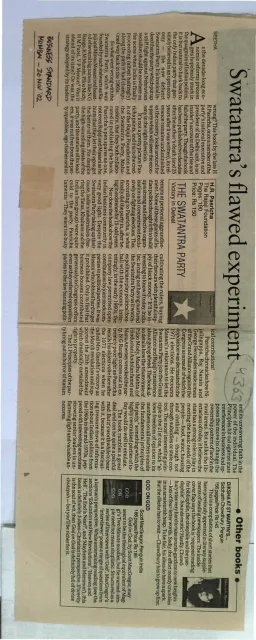
In the rendered pages, Seetha makes the case for the Swatantra Party as a neglected liberal-democratic tradition and a possible template for a contemporary centre-right political option. The article traces the party’s origins in opposition to Jawaharlal Nehru’s centralised economic planning and state capitalism, and presents its programme as defending individual rights, personal, intellectual and cultural freedoms, democratic institutions, and limited government. It also challenges the caricature of Swatantra as merely a laissez-faire party serving wealthy interests, emphasising its commitments to social justice, equality of opportunity, small traders, artisans, peasants and economic democracy.
In the rendered pages, the article argues that Swatantra’s historical weaknesses included tactical errors, internal personality clashes, and the 1971 electoral alliance against Indira Gandhi. It recounts the party’s dissolution in 1974 and considers whether its principles remain politically relevant. Seetha concludes that India lacks a sufficiently cogent centre-right voice: younger Indians increasingly value individual choice and freedom, while existing parties either offer populist subsidies or misunderstand the idea of minimum government. The article is therefore both a history of Swatantra and an argument for recovering its emphasis on freedom, restrained state power and economic liberalisation, while acknowledging the difficulties of translating that programme into a successful rural and electoral strategy.
Key points
- The article presents the Swatantra Party as a liberal-democratic alternative formed in opposition to Nehruvian centralised planning and state capitalism.
- It foregrounds Swatantra’s defence of individual rights, personal freedoms, democratic institutions and limited government.
- It disputes the portrayal of the party as unconcerned with poverty, noting its commitments to social justice, equality of opportunity and economic democracy.
- It recalls the party’s electoral successes in 1962 and 1967, followed by tactical mistakes, factional conflict and decline after 1971.
- It argues that post-liberalisation India still lacks a strong centre-right political voice committed to economic liberty.
- It suggests that younger Indians may be receptive to individual freedom and choice, but that rural voters and the broader electorate remain attached to state-provided subsidies.
- It distinguishes minimum government from the abolition of essential government responsibilities, and contrasts this ideal with Narendra Modi’s narrower emphasis on reducing red tape.
Metadata and summary are AI-extracted from the source PDF and reviewed for editorial accuracy. The original work is available via the Read PDF tab above (where present); paragraph-level citation inside the PDF is deferred to a future engagement.