essay · statement of principles
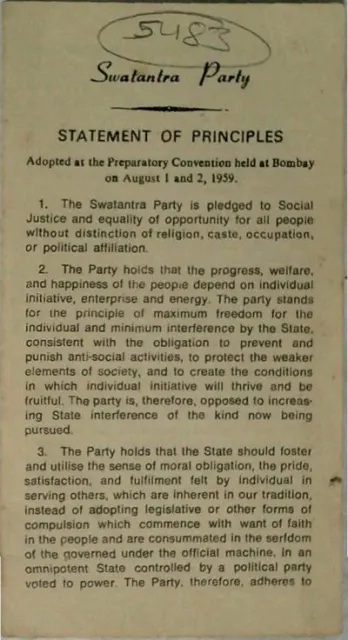
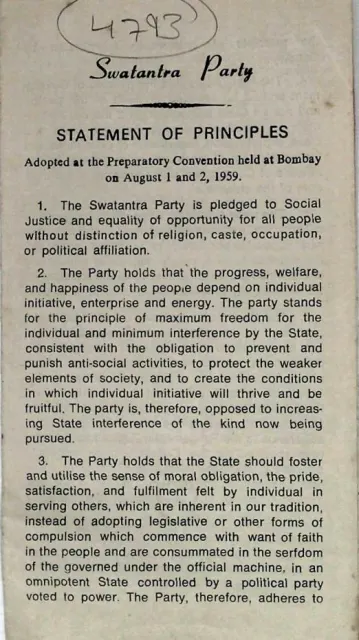
STATEMENT OF PRINCIPLES
Printed by: JAYANT ART PRINTERY PVT. LTD. TARDEO, BOMBAY-34. · Bombay · 1959
6 pages
Summary
This six-page statement, adopted at the Swatantra Party’s Preparatory Convention in Bombay on August 1 and 2, 1959, sets out 21 principles combining social justice with individual freedom, private initiative, and limited government. It affirms equality of opportunity without distinctions of religion, caste, occupation, or political affiliation, while arguing that the State should protect citizens and the weaker sections of society without replacing individual responsibility and enterprise with compulsion. The statement also invokes Gandhian trusteeship, faith in the people, truth, non-violence, and the preservation of spiritual and cultural values.
The economic programme rejects collectivisation, bureaucratic management, excessive State enterprise, and controls that restrict trade and investment. It supports secure property rights, self-employed peasant-proprietors, agricultural assistance, competitive industry, free distribution, restrained taxation, sound public finance, price stability, decentralised industry, and employment-generating development. The closing principles extend this position to labour protections and collective bargaining, an independent judiciary and judicial review, protection from political pressure on officials, and freedom of opinion for party members outside the statement’s fundamental principles.
Key points
- The party pledges social justice and equality of opportunity regardless of religion, caste, occupation, or political affiliation.
- Individual initiative, enterprise, and energy are presented as the basis of progress, welfare, and happiness, with maximum individual freedom and minimum State interference.
- The statement endorses Gandhian trusteeship, moral obligation, truth, non-violence, and the preservation of spiritual and cultural values.
- It defends private property, self-employed peasant-proprietors, agricultural incentives, and opposition to collectivisation and bureaucratic rural management.
- It favours competitive enterprise, limited State activity in industry and trade, and safeguards for labour against unreasonable profits, prices, and dividends.
- The programme calls for thrift in public expenditure, moderate taxation, opposition to abnormal deficit financing and excessive foreign borrowing, and resistance to inflation.
- It supports decentralised industry, full and lasting employment, workers’ organisation and collective bargaining, the rule of law, judicial independence, and constitutional judicial review.
- The party protects internal freedom of opinion on matters outside its fundamental principles.
Metadata and summary are AI-extracted from the source PDF and reviewed for editorial accuracy. The original work is available via the Read PDF tab above (where present); paragraph-level citation inside the PDF is deferred to a future engagement.