minutes
Swatantra Party Minutes of Meeting
Swatantra Party Parliamentary Office · New Delhi · 1967
2 pages
Summary
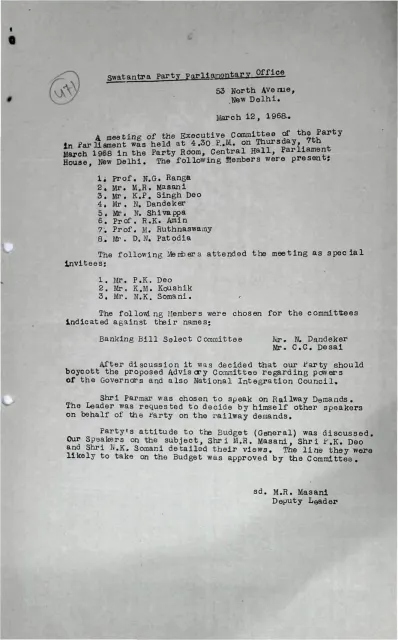
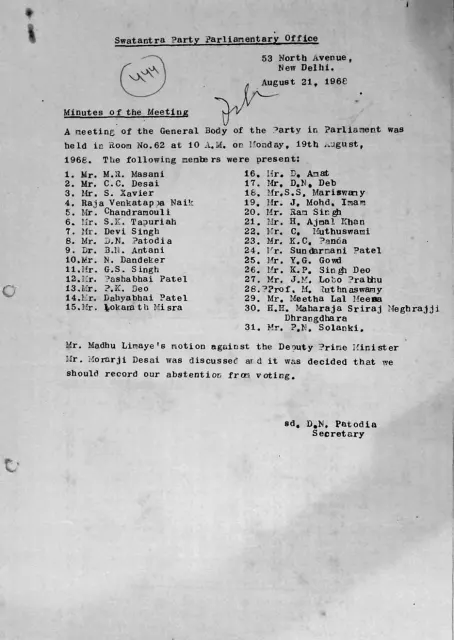
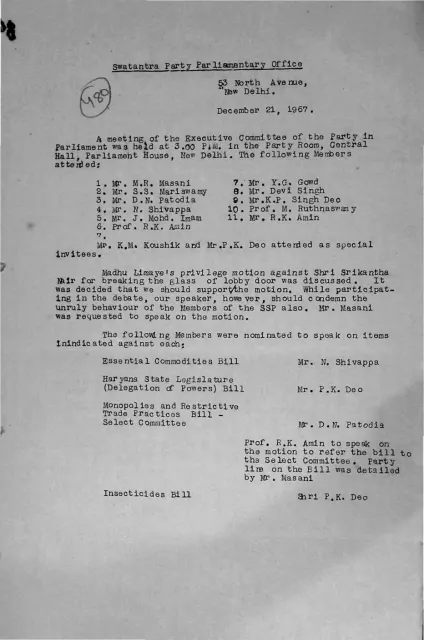
This two-page office record documents a meeting of the Swatantra Party Parliamentary Office Executive Committee held in Parliament House, New Delhi, on 21 December 1967. It lists the members and special invitees present, records the Party’s decision to support Madhu Limaye’s privilege motion against Shri Srikant Naik for breaking the glass of a lobby door, and assigns speakers to several parliamentary bills, including the Essential Commodities Bill, the Haryana State Legislature (Delegation of Powers) Bill, the Monopolies and Restrictive Trade Practices Bill, and the Insecticides Bill.
The minutes also record the Party’s position on whether its members should join inter-party Consultative Committees. Participation was made conditional on the Minister for Parliamentary Affairs accepting demands for statutory status, proper record-keeping, and limits on committee size. Finally, the committee approved three names for a South India team studying state projects. The document has no printed formal title or author byline and is signed by C. C. Desai as Secretary.
Key points
- The Executive Committee meeting took place at 3:00 p.m. on 21 December 1967 in the Party Room, Central Hall, Parliament House, New Delhi.
- The committee decided to support Madhu Limaye’s privilege motion against Shri Srikant Naik while condemning the unruly conduct of Swatantra Party members.
- Members were nominated to speak on bills concerning essential commodities, Haryana’s legislature, monopolies and restrictive trade practices, and insecticides.
- The Party opposed participation in Consultative Committees unless demands for statutory status, procedural records, and limits on committee size were accepted.
- A three-member team was approved to travel to South India to study the working of state projects.
- The record is issued on Swatantra Party Parliamentary Office letterhead and signed by C. C. Desai, Secretary.
Metadata and summary are AI-extracted from the source PDF and reviewed for editorial accuracy. The original work is available via the Read PDF tab above (where present); paragraph-level citation inside the PDF is deferred to a future engagement.