pamphlet · manifesto
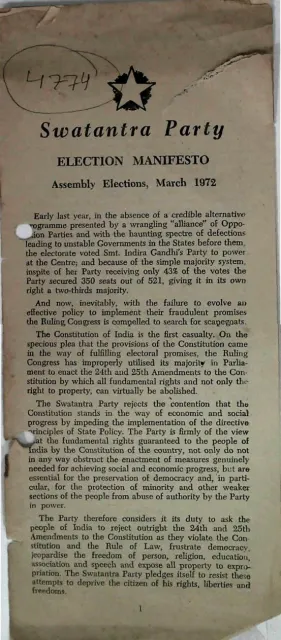
ELECTION MANIFESTO
For the Assembly Elections in several States in February 1972
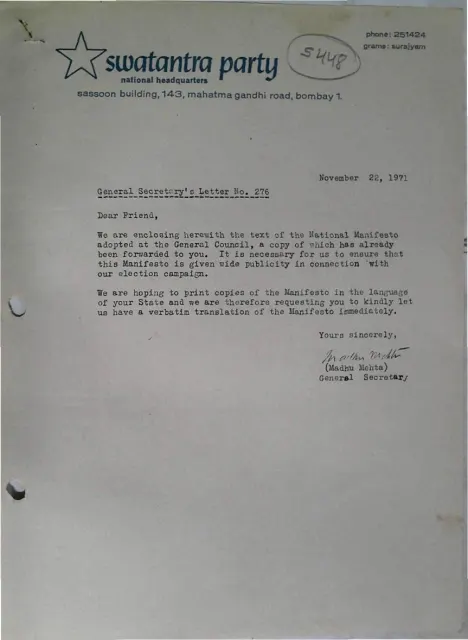
SWATANTRA PARTY · 1971
5 pages
Summary
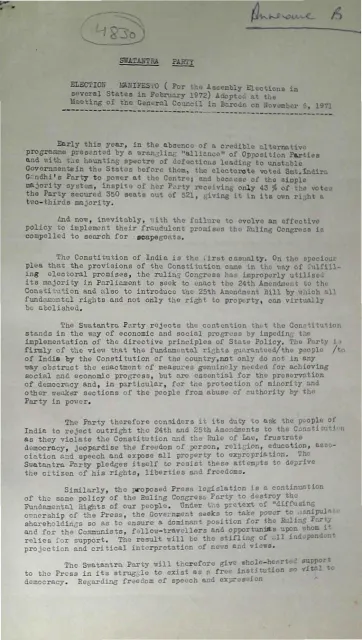
This five-page manifesto, adopted by the Swatantra Party General Council in Baroda on November 6, 1971, presents the party’s platform for the February 1972 Assembly elections. It attacks the ruling Congress for using its parliamentary majority to weaken constitutional protections, especially through the proposed Twenty-fourth and Twenty-fifth Amendments, and warns against restrictions on the press, imported publications, All-India Radio, and television. It also criticizes the government’s handling of inflation, unemployment, public-sector expansion, and economic stagnation.
Key points
- The manifesto argues that constitutional amendments proposed by the ruling Congress threaten fundamental rights, property rights, and the rule of law.
- It defends a free press and opposes government efforts to control newspapers, imported films and publications, All-India Radio, and television.
- It calls for government action against inflation, unemployment, floods, drought, and inadequate infrastructure, while limiting the state to legitimate and effective functions.
- It advocates a mixed economy in which government acts as a helper and regulator rather than as a participant in ordinary business.
- It supports private enterprise, restricted state ownership, protection for small traders and self-employed artisans, moderate taxation, and opposition to excessive licensing and controls.
- Its agricultural policy emphasizes higher production, secure tenancy, fair rents, credit, inputs, insurance, support prices, and protection from price fluctuations.
- The numbered principles endorse property compensation, competitive industry, collective bargaining, fair wages, administrative integrity, Lokpal and Lokayuktas, and decentralized honest government.
- The manifesto closes by invoking the Gandhian principle of giving priority to the rule of Dharma as a basis for moral and material progress.
Metadata and summary are AI-extracted from the source PDF and reviewed for editorial accuracy. The original work is available via the Read PDF tab above (where present); paragraph-level citation inside the PDF is deferred to a future engagement.