minutes · report
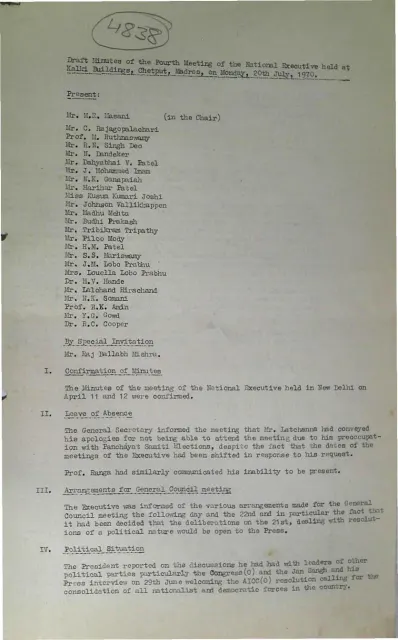
Draft Minutes of the Fourth Meeting of the National Executive held at Kalla Buildings, Chepauk, Madras, on Monday, 20th July, 1970.
SWATANTRA PARTY · Madras · 1970
15 pages
Summary
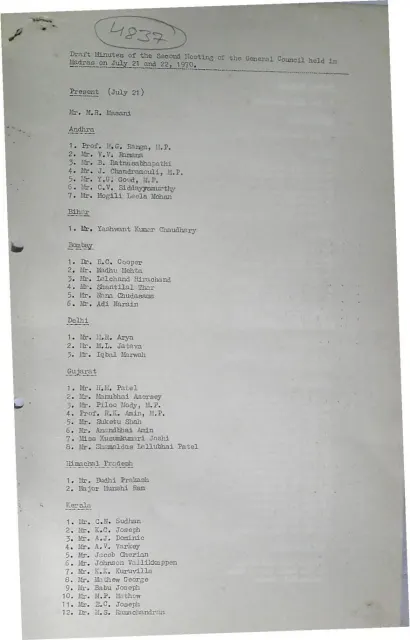
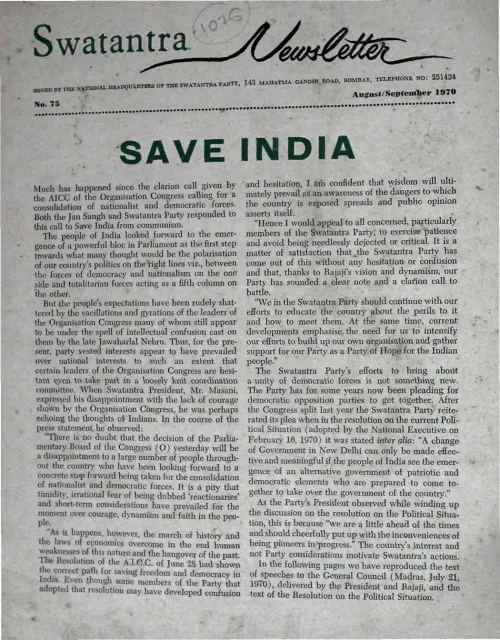
These draft minutes record the Swatantra Party National Executive’s fourth meeting, held at Kalla Buildings, Chepauk, Madras, on 20 July 1970. The meeting confirmed earlier minutes, noted absences, reviewed arrangements for the forthcoming General Council, and considered the political situation. The Executive welcomed the All-India Congress Committee’s call for consolidation among nationalist and democratic forces, while discussing the proposed formation of a broader parliamentary bloc involving the Swatantra Party, Jan Sangh, and Congress (Organisation). It also adopted a resolution recommending cooperation while retaining the party’s independent opposition role and vigilance toward any coalition government.
The remaining minutes address party organisation, including a Fundamental Rights campaign, an Anti-Naxalite Day, the proposed formation of farmers’ associations, candidate selection, the next national convention, fundraising, and the party’s national bank account. Reports on Orissa and Gujarat emphasise coalition stability, party unity, and internal discipline; the Executive declined to reconsider the expulsion of C. C. Desai and addressed vacancies and appeals within party bodies. Annexures A–F contain draft resolutions on political consolidation, West Bengal, Cambodia, nationalisation of cotton and distributive trades, the Bihar land-grab agitation, and the agricultural wealth tax. Across these documents, the party combines constitutional and civil-liberties arguments with opposition to communist movements, economic nationalisation, coercive land redistribution, and increased centralisation.
Key points
- The National Executive endorsed cooperation among nationalist and democratic forces in response to the AICC’s call for political consolidation.
- The Swatantra Party insisted that cooperation would not end its role as an independent opposition party.
- Party organisational priorities included defending Fundamental Rights, building farmers’ associations, preparing candidates, and strengthening fundraising.
- The minutes report party positions on coalition government in Orissa, political opposition in Gujarat, and disciplinary action against C. C. Desai.
- The annexures oppose communist activity and the political situations in West Bengal and Bihar, including land seizures and alleged state connivance.
- The annexed economic resolutions reject nationalisation of cotton and distributive trades and oppose the agricultural wealth tax as harmful to production.
- The Cambodia resolution frames India’s foreign policy as excessively aligned with the Soviet Union and supports the intervention by South Vietnamese and United States forces.
Metadata and summary are AI-extracted from the source PDF and reviewed for editorial accuracy. The original work is available via the Read PDF tab above (where present); paragraph-level citation inside the PDF is deferred to a future engagement.