
essay
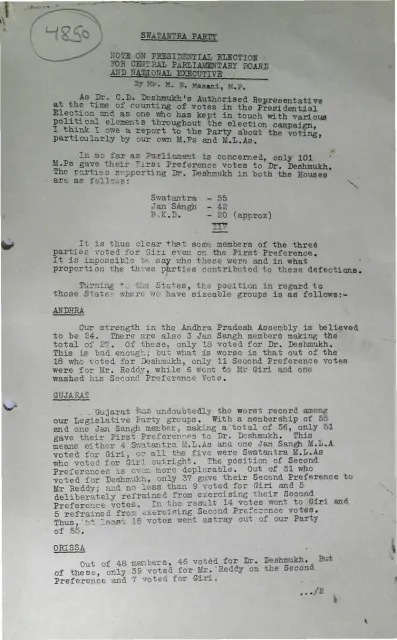
NOTE ON PRESIDENTIAL ELECTION FOR CENTRAL PARLIAMENTARY BOARD AND NATIONAL EXECUTIVE
NEW DELHI · 1969
2 pages
Summary
This two-page Swatantra Party note, attributed to M. R. Masani and dated 27 August 1969, reviews voting in the presidential election for the Central Parliamentary Board and National Executive. It reports that 101 Members of Parliament gave their first-preference votes to C. D. Deshmukh: 55 from the Swatantra Party, 42 from the Jan Sangh, and approximately 20 from the B.K.D. Masani argues that some members of all three parties defected even at the first-preference stage, but that the Swatantra Party’s record was comparatively less unsatisfactory.
The note then examines state-level voting in Andhra Pradesh, Gujarat, Orissa, Rajasthan, and Tamil Nadu. It identifies defections, abstentions, and the failure to transfer second-preference votes to Mr. Reddy as key causes of Deshmukh’s defeat. Its concluding argument is that stronger party discipline could have produced a different result: Deshmukh’s first-preference supporters, had they consolidated their second preferences behind Reddy, would have secured his election by a comfortable margin. Masani assigns blame for the outcome to the Swatantra Party, Congress, and B.K.D. together.
Key points
- The note records 101 parliamentary first-preference votes for C. D. Deshmukh, including 55 from Swatantra, 42 from Jan Sangh, and approximately 20 from B.K.D.
- It attributes the presidential-election result partly to defections from the declared party positions.
- State-level examples from Andhra Pradesh, Gujarat, Orissa, Rajasthan, and Tamil Nadu document first- and second-preference voting patterns.
- Gujarat is presented as having the weakest record among the Swatantra legislative groups, with substantial defections and abstentions.
- The note states that party discipline was weak wherever the parties had sizeable groups.
- Masani concludes that coordinated second-preference voting for Mr. Reddy could have defeated Giri by a comfortable margin.
- Responsibility for the failure is shared among the Swatantra Party, Congress, and B.K.D.
Metadata and summary are AI-extracted from the source PDF and reviewed for editorial accuracy. The original work is available via the Read PDF tab above (where present); paragraph-level citation inside the PDF is deferred to a future engagement.
Related across the archive
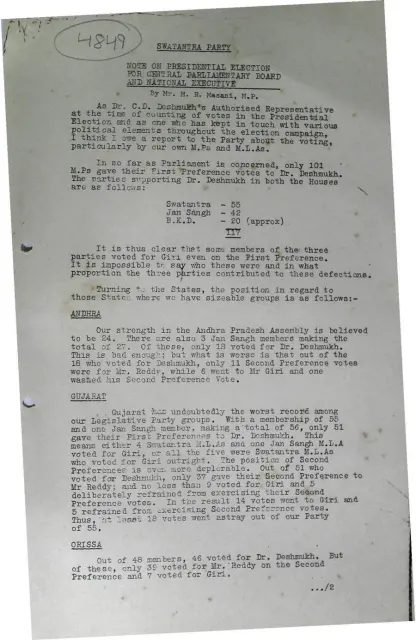 Primary workNOTE ON PRESIDENTIAL ELECTION FOR CENTRAL PARLIAMENTARY BOARD AND NATIONAL EXECUTIVE
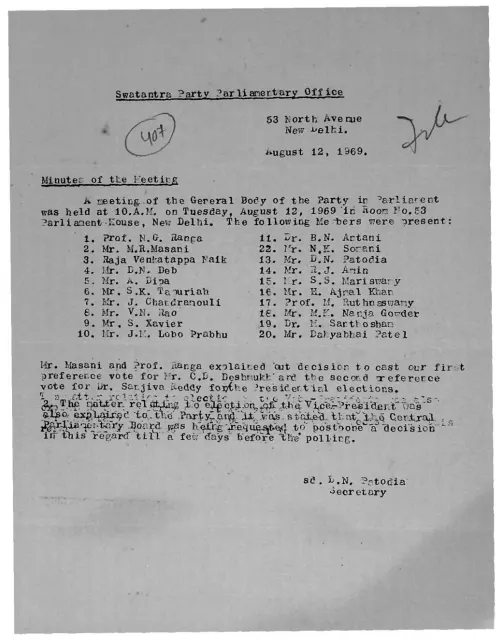 Primary workMinutes of the Meeting
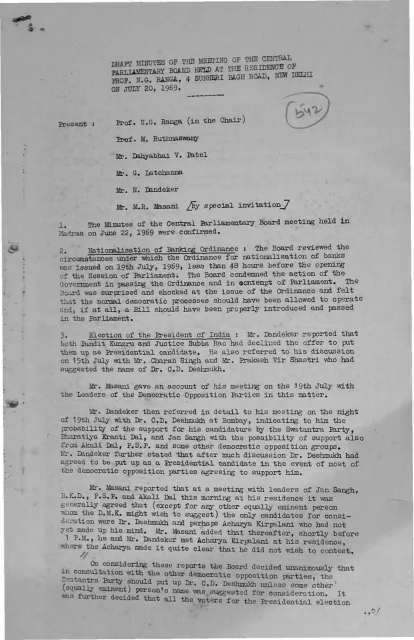 Primary workDRAFT MINUTES OF THE MEETING OF THE CENTRAL PARLIAMENTARY BOARD HELD AT THE RESIDENCE OF PROF. N.G. RANGA, 4 SUNHERI BAGH ROAD, NEW DELHI ON JULY 20, 1969.
 OpinionThe Swatantra Way for Forging a Formidable Coalition
 ExcerptThe Education of the Electorate