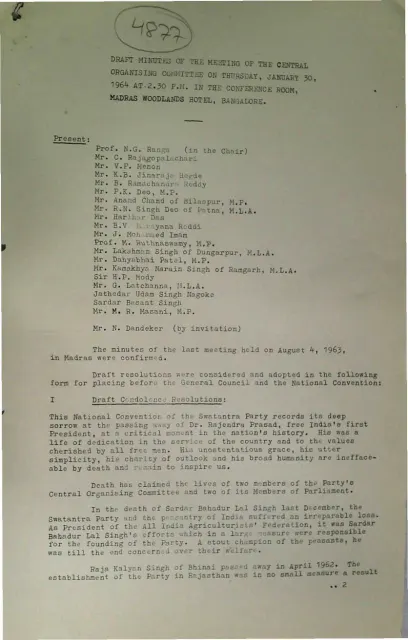
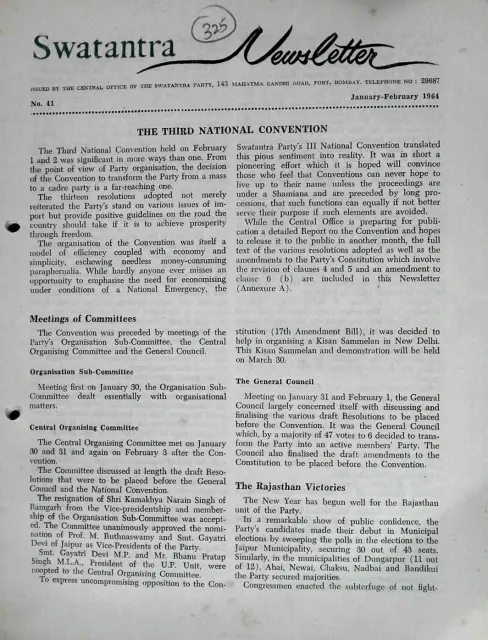
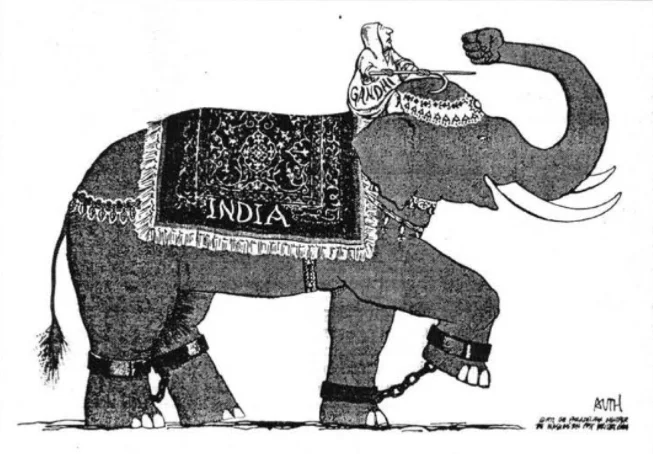
resolution
Text of Resolutions
SWATANTRA PARTY · Bangalore · 1964
4 pages
Summary
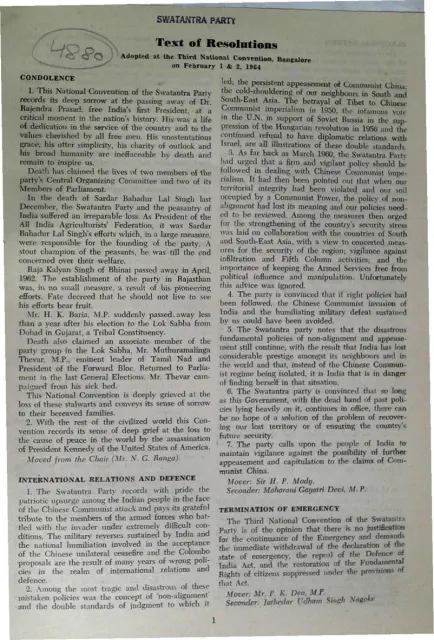
Adopted at the Swatantra Party’s Third National Convention in Bangalore on February 1–2, 1964, this four-page document records the party’s resolutions on national mourning, international relations, defence, emergency powers, elections, economic policy, banking, land reform, party organisation, federalism, and constitutional amendments. The opening resolutions honour Rajendra Prasad and other deceased party figures, condemn the assassination of President Kennedy, and criticise what the party calls the government’s appeasement of Communist China and the failures of non-alignment. They call for stronger regional security cooperation in South-East Asia, vigilance against infiltration, and an armed forces insulated from political manipulation.
The resolutions present the Swatantra Party as a constitutional and economically liberal alternative to Congress planning. They demand electoral reform, coordinated democratic opposition, an end to the Emergency, restoration of fundamental rights, and greater redistribution of power to the states. Their economic programme rejects the existing Five-Year Plans and state monopolies while retaining a role for government in infrastructure, basic necessities, stable prices, credit, education, and social welfare. The document opposes the proposed Seventeenth Amendment, state banking monopoly, coercive land collectivisation, and the expansion of executive control, while also setting out detailed rules for party membership and organisation.
Key points
- The convention records the party’s grief over the deaths of Rajendra Prasad, Sardar Bahadur Lal Singh, Raja Kalyan Singh, H. K. Baria, and Muthuramalinga Thevar, and condemns the assassination of President Kennedy.
- The party condemns Communist China’s conduct and the government’s non-aligned response, calling for a firmer South-East Asian security policy and politically independent armed forces.
- The resolutions demand termination of the Emergency, repeal of the Defence of India Act, and restoration of fundamental rights.
- Electoral reform proposals include an independent commission, cleaner elections, reduced election costs, limits on administrative interference, and better proportional representation.
- The document calls for democratic opposition parties to cooperate against Congress while strengthening their own organisation.
- The Swatantra alternative combines criticism of state planning and monopolies with a limited public role in infrastructure, basic necessities, monetary stability, education, and welfare.
- The party opposes the Seventeenth Constitutional Amendment, coercive land collectivisation, and nationalisation of banking, while supporting stronger state powers and internal party reforms.
Metadata and summary are AI-extracted from the source PDF and reviewed for editorial accuracy. The original work is available via the Read PDF tab above (where present); paragraph-level citation inside the PDF is deferred to a future engagement.