minutes · report
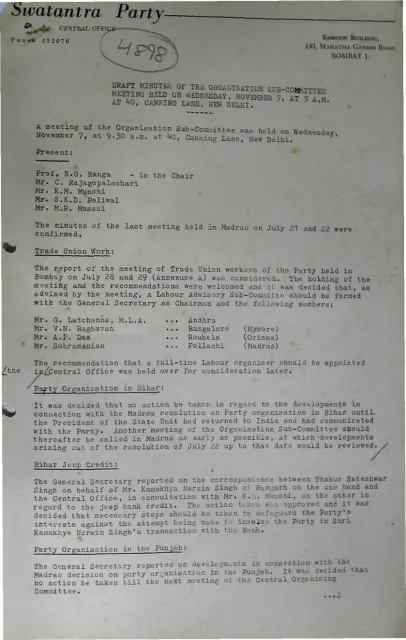
DRAFT MINUTES OF THE ORGANISATION SUB-COMMITTEE MEETING HELD ON WEDNESDAY, NOVEMBER 7, AT 9 A.M. AT 40, CANNING LANE, NEW DELHI.
Swatantra Party — Central Office · Bombay · 1962
8 pages
Summary
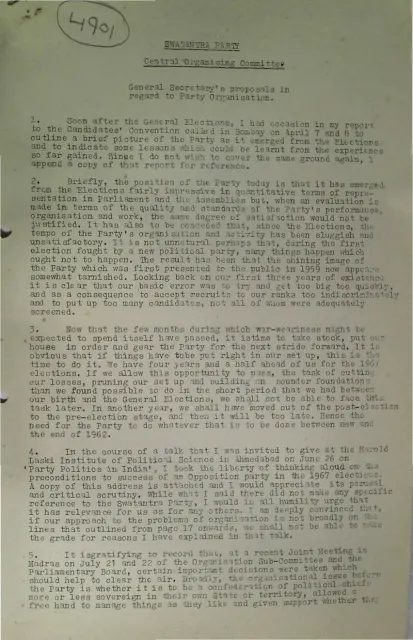
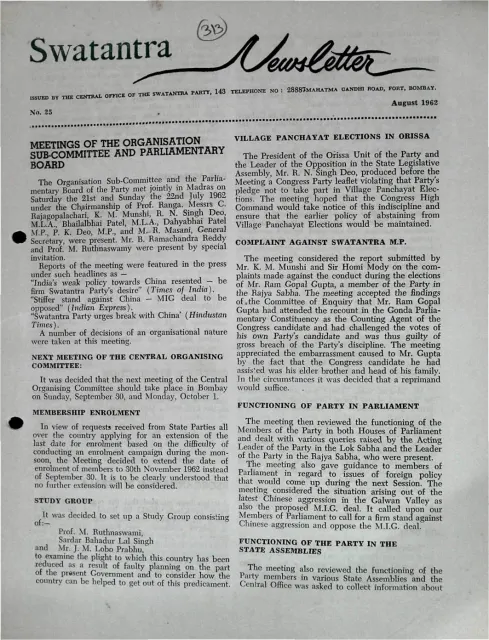
This eight-page Swatantra Party Central Office compilation brings together draft minutes of the Organisation Sub-Committee meeting held in New Delhi on November 7, 1962; minutes of a Bombay trade-union workers’ meeting held on July 28–29, 1962; and M. R. Masani’s attached memorandum on party organisation, dated August 17, 1962. The Organisation Sub-Committee reviewed trade-union work, party organisation in Bihar and Punjab, a dispute involving jeep-bank credit, member enrolment, and the proposed reconstruction of state units. It approved the formation of a Labour Advisory Sub-Committee and deferred several organisational decisions until further meetings.
The trade-union minutes reaffirm the Party’s opposition to creating Swatantra-dominated unions or another centrally controlled trade-union federation. Instead, members were encouraged to build independent unions, educate workers about political exploitation, and represent workers’ economic grievances. The proposed Labour Advisory Committee was assigned functions including advising the Party on labour, gathering information, training party members in genuine trade unionism, liaising with legislators, and promoting improvements in housing, education, and medical relief. Masani’s memorandum argues that the Party’s post-election organisation was inadequate and proposes full-time organisers, earlier candidate selection, stronger links between central and state units, and a 1963 organisational budget of Rs. 250,000.
Key points
- The Organisation Sub-Committee reviewed party administration across Bihar and Punjab and postponed some decisions pending further organisational meetings.
- A Labour Advisory Sub-Committee was proposed, with the General Secretary as chair and representatives from several regions.
- The trade-union meeting rejected the creation of Swatantra-controlled unions and instead favoured independent, worker-managed trade unions.
- The Labour Advisory Committee was assigned responsibilities for policy advice, information gathering, worker education, training, legislative liaison, and social relief.
- State units were asked to submit panels of fifty members from which reorganised executive committees and office-bearers could be selected.
- Masani’s memorandum criticises slow and unsatisfactory party activity after the general election and calls for disciplined expansion before the 1967 elections.
- The memorandum proposes approximately twenty-five full-time organisers initially, with a stated annual budget of Rs. 250,000 for 1963.
- The organisational model combines local autonomy with central coordination through elected state executives and centrally appointed organisers.
Metadata and summary are AI-extracted from the source PDF and reviewed for editorial accuracy. The original work is available via the Read PDF tab above (where present); paragraph-level citation inside the PDF is deferred to a future engagement.