correspondence
Letter from J B Kriplani
Bombay · 1975
9 pages
Summary
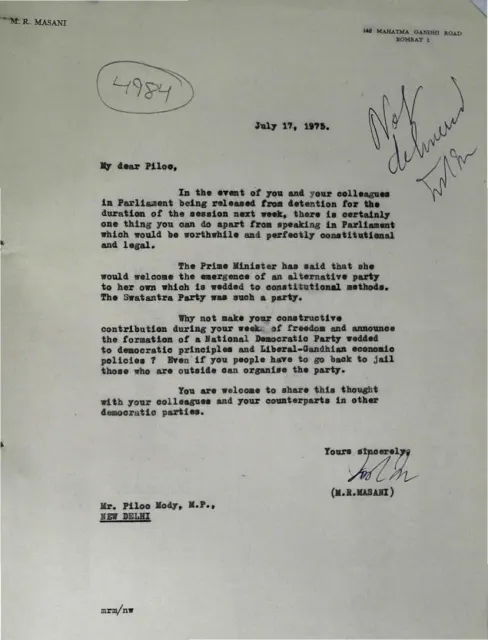
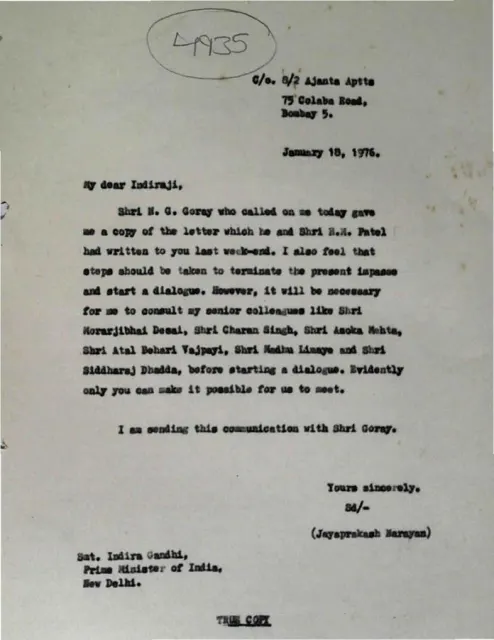
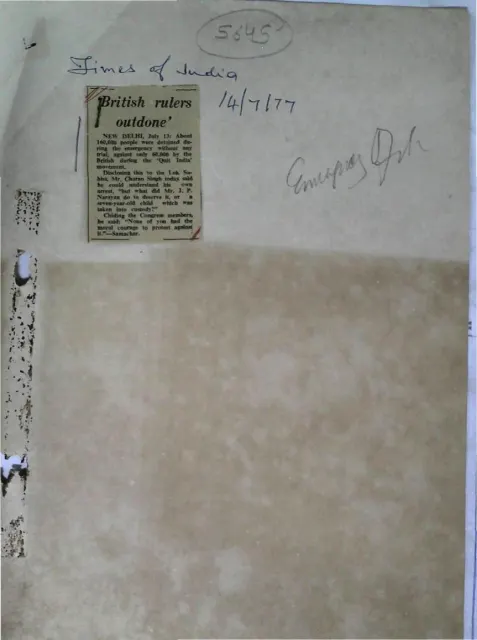
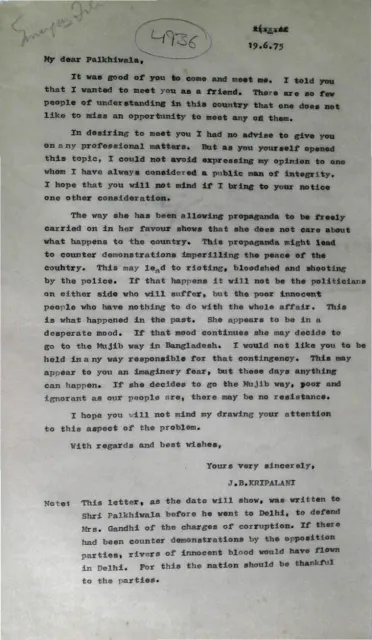
This nine-page English archival dossier brings together J. B. Kripalani’s correspondence with Prime Minister Indira Gandhi during the Emergency of 1975, followed by his three-page essay “Who Is To Bell The Cat”. In a letter dated 19 June, Kripalani warns Nani Palkhivala that political propaganda could provoke counter-demonstrations, rioting, bloodshed and police firing. He is particularly concerned that Indira Gandhi might resort to the “Mujib way” of Bangladesh, leaving poor and politically uninformed people unable to resist. In July, he asks the government to disclose reliable information about the health of detained opposition leaders Jayaprakash Narayan and Morarji Desai, invoking the British government’s medical arrangements for Gandhi during the Quit India Movement. Gandhi replies that both men are well; Kripalani later challenges this reassurance and presses for the release of detained leaders and a dialogue to restore normality.
The later letters focus on the health of Jayaprakash Narayan, Morarji Desai, Atal Bihari Vajpayee and Nabakrishna Choudhury in detention, and on the moral and political consequences of prolonged imprisonment. The essay argues that political conditions cannot be called normal while the Emergency continues and opposition leaders remain in jail. Kripalani contends that neither the public nor Parliament can negotiate a settlement under these conditions: the detained leaders must first be released so that they can meet as free men and women. He rejects official portrayals of the opposition as fascist, violent or unpatriotic, and predicts that detained leaders would receive a popular welcome when the jail gates opened.
Key points
- Kripalani warns Nani Palkhivala that political propaganda during the Emergency could trigger counter-demonstrations, violence and police firing.
- He asks the government to publish authoritative medical information about the health of detained opposition leaders.
- The correspondence records a disagreement between Kripalani and Indira Gandhi over the health and treatment of Jayaprakash Narayan and other detainees.
- Kripalani repeatedly urges the release of opposition leaders and the opening of a dialogue to restore political normality.
- The essay argues that an Emergency cannot coexist with claims that political conditions are normal.
- Kripalani maintains that the detained opposition leaders, rather than Parliament or unauthorised individual spokespeople, must participate in any meaningful settlement.
- He defends the patriotism and democratic legitimacy of opposition leaders whom the government and ruling party portray as enemies of the country.
Metadata and summary are AI-extracted from the source PDF and reviewed for editorial accuracy. The original work is available via the Read PDF tab above (where present); paragraph-level citation inside the PDF is deferred to a future engagement.