pamphlet
The Conduct of meetings
11 pages
Summary
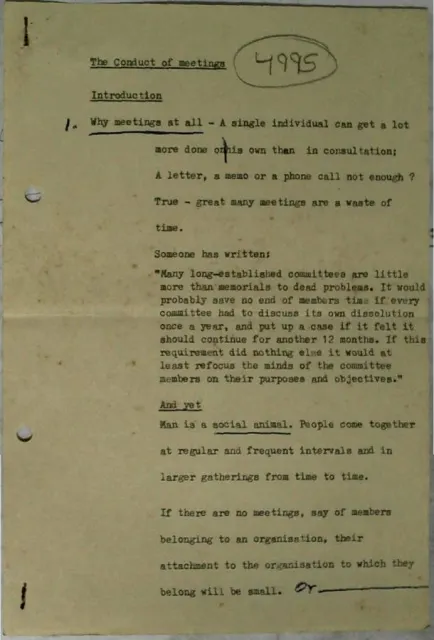
The Conduct of meetings is a practical, unattributed guide to organisational meetings. It begins by acknowledging that meetings can waste time, while arguing that face-to-face gatherings remain necessary because they create group identity, pool shared knowledge, clarify collective aims, generate commitment to decisions, connect members with leadership, and give participants a sense of status and belonging. It distinguishes public, council, and committee meetings, while focusing especially on the functional committee meeting that conducts an organisation’s business.
The pamphlet then sets out procedures for preparing and running meetings. It recommends consulting the chair and essential participants, choosing convenient and accessible venues, giving adequate notice, and arranging an agenda that places demanding or creative items early while allowing for attention lapses and time limits. It covers resolutions, background papers, room layout, equipment, the opening of proceedings, voting, and the respective duties of the chair and secretary. Its ideal chair is impartial, restrained, procedurally fair, attentive to quieter or weaker participants, and committed to guiding the group toward efficient discussion and decisions. The final page briefly addresses the secretary’s administrative and record-keeping responsibilities and distinguishes minutes from a general record of proceedings.
Key points
- Meetings are defended as essential to organisational identity, shared knowledge, collective commitment, and accountability.
- The text identifies public, council, and committee meetings as three broad categories.
- Effective preparation requires suitable timing, adequate notice, accessible venues, clear agendas, relevant papers, and practical room arrangements.
- Agendas should account for participants’ attention, place demanding items early, allocate time, and remain open to sensible changes.
- The chair should be fair, concise, non-dominating, and responsible for protecting participation and moving discussion toward decisions.
- The secretary issues notices, prepares agendas and supporting papers, maintains records, implements decisions, and drafts minutes.
- The pamphlet treats orderly meeting procedure as a form of organisational governance rather than mere administrative formality.
Metadata and summary are AI-extracted from the source PDF and reviewed for editorial accuracy. The original work is available via the Read PDF tab above (where present); paragraph-level citation inside the PDF is deferred to a future engagement.