office record · working paper
Organisation Techniques
1979
6 pages
Summary
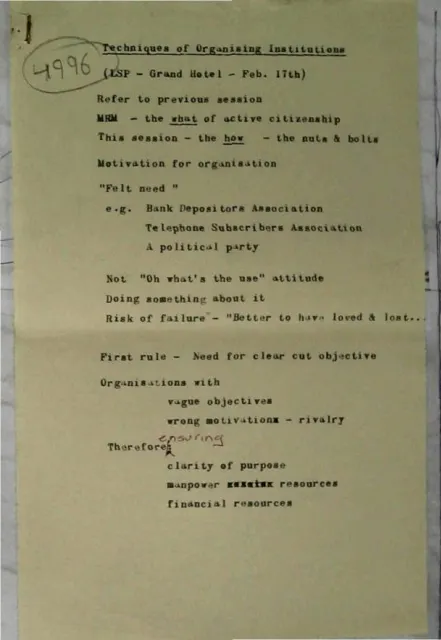
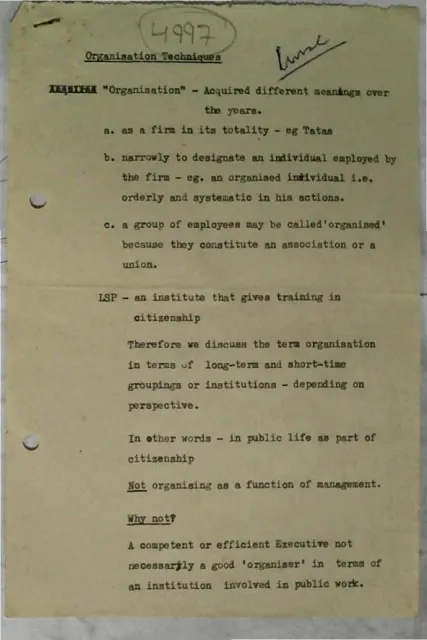
“Organisation Techniques” is a practical working paper on the formation and functioning of civic and political organisations. It distinguishes several uses of “organisation”—a firm in its entirety, an orderly individual, and an association or union—and places organisation within public life and citizenship rather than treating it simply as a management function. The paper notes that efficient executives, professionals, and businesspeople are not necessarily effective organisers of public institutions, though training or “orientation” may help. It also identifies recurring weaknesses: vague objectives, rivalry, committees that do little, burdens carried by only a few people, and organisations becoming “paper bodies” disconnected from felt needs.
The paper then offers a deliberately humorous example of how an association can be launched around a social problem, complete with a president, office-bearers, a ministerial inauguration, publicity, and no subsequent activity. Against this model, it recommends establishing need, discussing whether a separate organisation is necessary, identifying committed participants, assessing time and funds, preparing a feasibility report, deliberating on it, and only then proceeding. Guidance on existing organisations covers constitutional arrangements and office-bearers, fundraising through subscriptions, donations, souvenirs, functions, and conference fees, as well as communications through circulars, informal gatherings, and newsletters. The final visible section turns to the conduct of meetings and refers readers to attached notes.
Key points
- The paper defines organisation in institutional, individual, and associational senses.
- It treats organisation as part of public life and citizenship, not merely as a management technique.
- It warns that competent executives and successful businesspeople may still be poor public organisers.
- It diagnoses vague objectives, rivalry, inactive committees, absentee activists, and organisations detached from felt needs.
- It recommends a staged process for creating an organisation, beginning with demonstrated need and a feasibility report.
- It discusses practical fundraising methods, including subscriptions, donations, souvenirs, functions, and conference charges.
- It emphasises regular communications and newsletters as links that sustain member involvement.
- It closes with a brief reference to meeting conduct and attached notes not included in the rendered pages.
Metadata and summary are AI-extracted from the source PDF and reviewed for editorial accuracy. The original work is available via the Read PDF tab above (where present); paragraph-level citation inside the PDF is deferred to a future engagement.