minutes · report
Swatantra Party Minutes of Meeting
Swatantra Party Parliamentary Office · New Delhi · 1967
2 pages
Summary
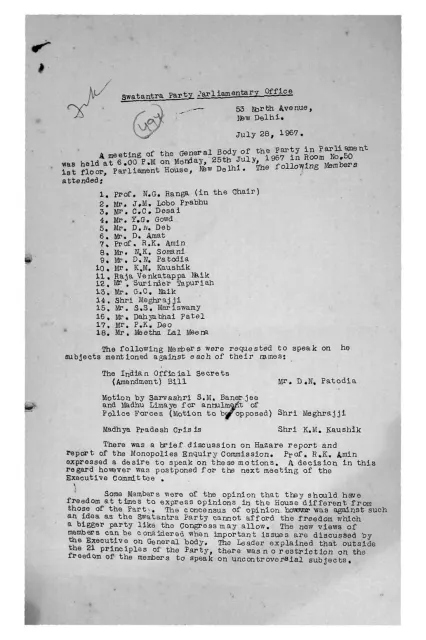
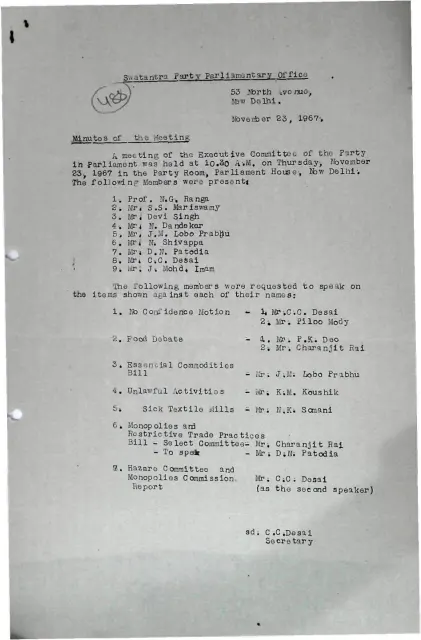
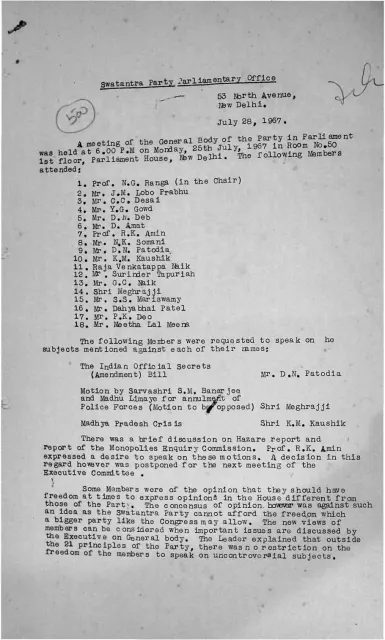
This two-page Swatantra Party Parliamentary Office record, dated 28 July 1967, reports on a General Body meeting held in Parliament House on 25 July. It lists the eighteen members present, identifies topics assigned for discussion—including the Indian Official Secrets (Amendment) Bill, a motion concerning the annulment of a Police Forces motion, and the Madhya Pradesh crisis—and records brief discussion of the Hazare report and the Monopolies Enquiry Commission report.
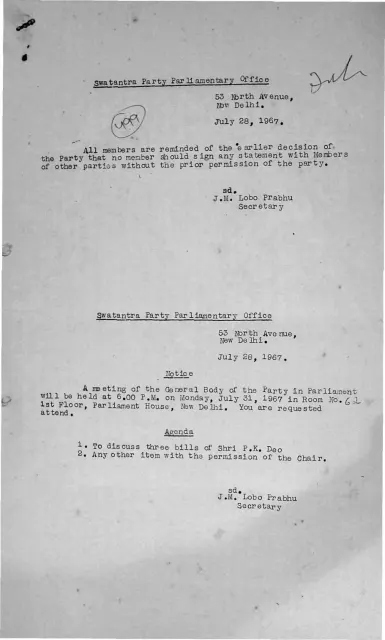
The minutes also capture the party’s position on parliamentary discipline and member freedom. Although some members argued that they should be able to express views in the House that differed from the party, the recorded consensus was that the Swatantra Party could not permit the same degree of freedom as a larger party such as Congress. The Leader nevertheless stated that, outside the party’s 21 principles, members faced no restriction on speaking about non-controversial subjects. The record further reports D. N. Patodia’s assessment of Naxalbari and West Bengal, describes the movement there as politically motivated by the Communist Party (Marxist), and notes the party’s preference for allowing the incumbent Chief Minister to form a government with Congress support. Members were reminded that they should give no notice of bills or resolutions without prior party permission.
Key points
- The record concerns a Swatantra Party General Body meeting held on 25 July 1967 and dated 28 July 1967.
- Eighteen members are listed as attending, with Prof. N. G. Ranga in the chair and J. M. Lobo Prabhu as secretary.
- The agenda included the Indian Official Secrets (Amendment) Bill, a Police Forces motion, and the Madhya Pradesh crisis.
- The meeting briefly discussed the Hazare report and the Monopolies Enquiry Commission report.
- The party debated whether parliamentary members should be free to express views differing from the party line.
- D. N. Patodia reported on Naxalbari and West Bengal and described the movement there as politically motivated by the Communist Party (Marxist).
- Members were instructed to obtain prior party permission before giving notice of bills or resolutions.
Metadata and summary are AI-extracted from the source PDF and reviewed for editorial accuracy. The original work is available via the Read PDF tab above (where present); paragraph-level citation inside the PDF is deferred to a future engagement.