notice
BULLETIN—PART II
General Information relating to Parliamentary and other matters
1965
2 pages
Summary
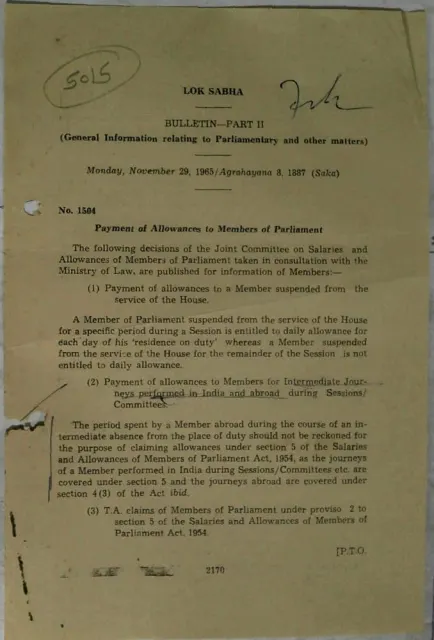
This two-page Lok Sabha Bulletin—Part II, dated November 29, 1965, publishes administrative decisions concerning Members of Parliament. Item No. 1504 sets out rules on the payment of allowances to Members suspended from the service of the House, stating that entitlement depends on whether the suspension lasts for a specified period or the remainder of the Session. It also addresses allowances for intermediate journeys undertaken in India and abroad during Sessions or committee work, including air, rail, road, and air-cum-rail travel.
The bulletin further explains three categories of travel-allowance claims under the amended Salaries and Allowances of Members of Parliament Act, 1954: journeys using air-cum-rail routes, one-way air travel combined with rail or road travel, and circuitous air routes. Item No. 1505 records an amendment to the Housing and Telephone Facilities (Members of Parliament) Rules, 1956, raising the annual limit of free local telephone calls from 1800 to 3600, effective March 13, 1965. The notice is signed by S. L. Shakdher, Secretary.
Key points
- The bulletin is an official Lok Sabha administrative notice dated November 29, 1965.
- Members suspended for a specified period during a Session remain entitled to daily allowance for each day of their residence on duty.
- Members suspended for the remainder of a Session are not entitled to daily allowance.
- Travel abroad during an intermediate absence is excluded when calculating certain allowances, while journeys in India and abroad are governed by separate statutory provisions.
- The notice specifies allowance rules for air-cum-rail journeys, mixed air and rail or road journeys, and circuitous air routes.
- The annual limit of free local telephone calls for Members of Parliament was raised from 1800 to 3600.
Metadata and summary are AI-extracted from the source PDF and reviewed for editorial accuracy. The original work is available via the Read PDF tab above (where present); paragraph-level citation inside the PDF is deferred to a future engagement.