letter
Letter to Mr Minoo Masani
Swatantra Party Central Office · New Delhi · 1968
3 pages
Summary
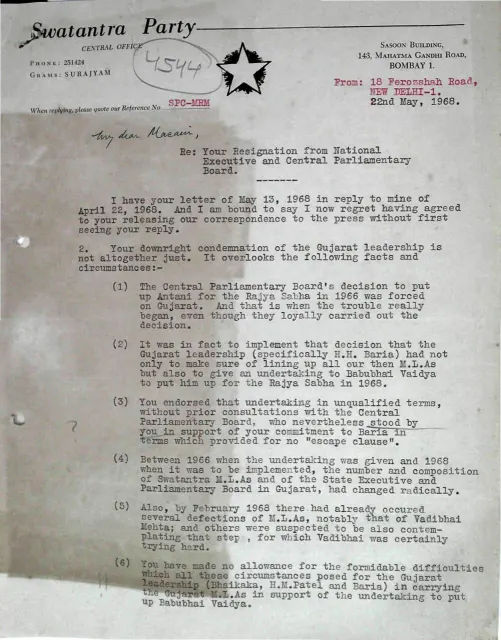
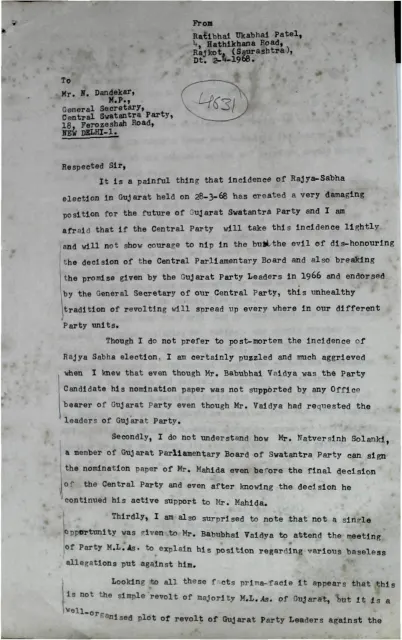
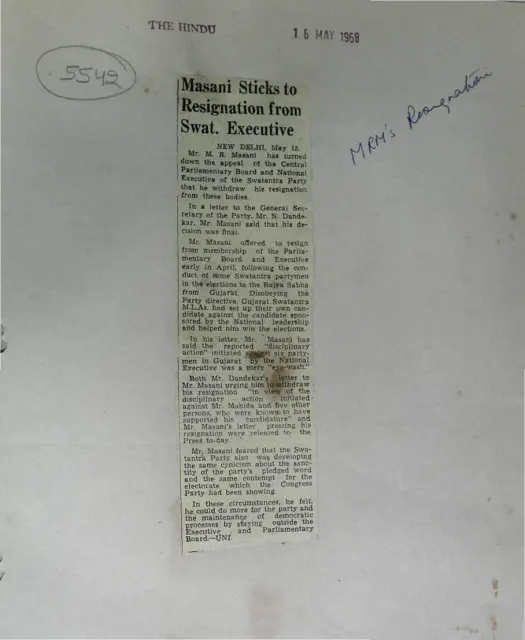
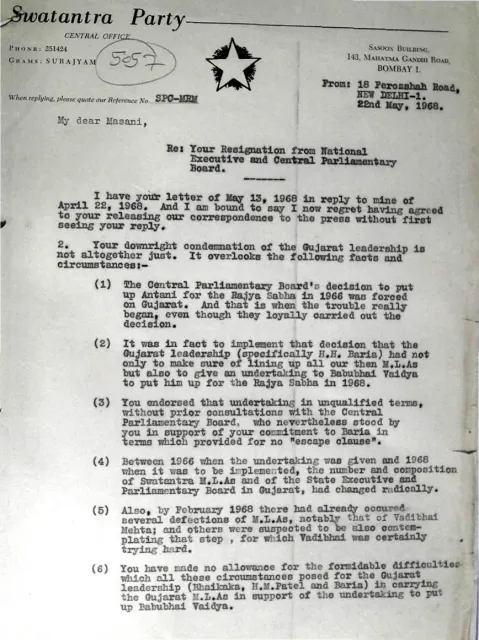
This 22 May 1968 letter from the Swatantra Party Central Office responds to Minoo Masani’s resignation from the National Executive and Central Parliamentary Board. The unnamed signatory argues that Masani’s condemnation of the Gujarat leadership is unfair because it overlooks the party’s earlier decision to support Babubhai Vaidya for the Rajya Sabha, the Gujarat leadership’s undertaking to implement that decision, changes in the party’s legislators between 1966 and 1968, defections, and the practical difficulties faced by Gujarat leaders in securing support for Vaidya.
The letter also defends the Central Parliamentary Board and National Executive against Masani’s description of their conduct as “eye wash.” It says the bodies considered the matter extensively, weighed inaction, sweeping disciplinary action, and the more limited course ultimately adopted, and concludes that disciplinary action against the defectors was necessary. At the same time, the writer rejects an ideal of absolute procedural purity, warning that trying to impose “puristic righteousness” in party organisation would risk disaster. The three-page document ends with a handwritten signature that cannot be confidently identified.
Key points
- The letter replies to Minoo Masani’s 13 May 1968 resignation letter and regrets that the earlier correspondence was released to the press without first seeing Masani’s reply.
- It challenges Masani’s condemnation of the Gujarat leadership by listing six overlooked facts and circumstances.
- The author describes the 1966 decision to support Babubhai Vaidya for the Rajya Sabha and the Gujarat leadership’s undertaking to implement it.
- The letter notes changes in the number and composition of Swatantra legislators, defections, and the resulting difficulty of carrying out the undertaking.
- It defends the Central Parliamentary Board and National Executive’s deliberations against charges of inaction and “eye wash.”
- The author regards disciplinary action against defectors as necessary but rejects “puristic righteousness” as an organisational principle.
- The sender remains unidentified because the handwritten signature on the final page is illegible.
Metadata and summary are AI-extracted from the source PDF and reviewed for editorial accuracy. The original work is available via the Read PDF tab above (where present); paragraph-level citation inside the PDF is deferred to a future engagement.