Summary
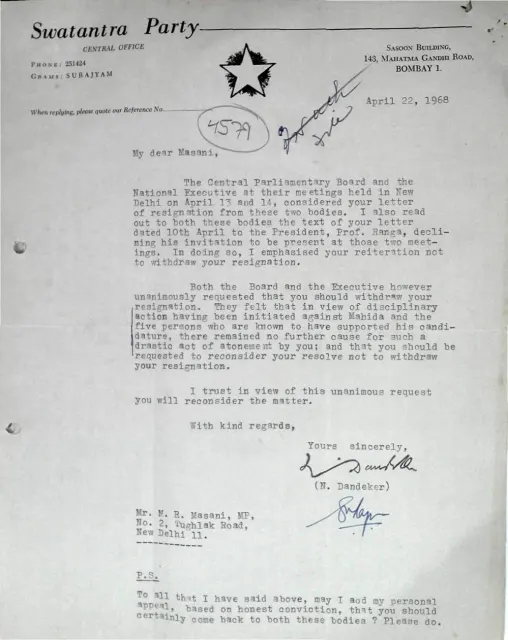
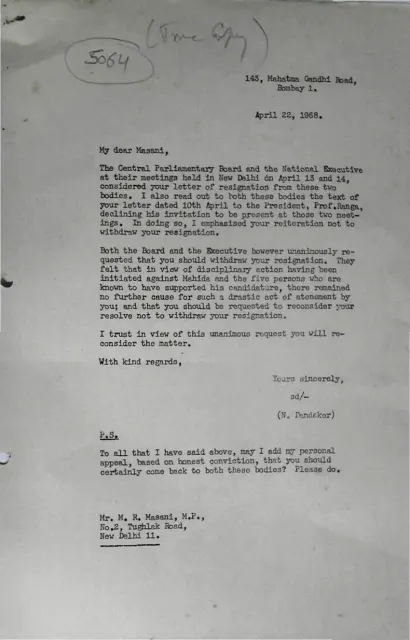
This three-page correspondence records a dispute within the Swatantra Party in April–May 1968. In his 22 April letter, N. Dandeker tells Minoo Masani that the Central Parliamentary Board and National Executive have considered Masani’s resignation and unanimously asked him to withdraw it. Dandeker argues that disciplinary action against Mahida and five people who supported his candidacy removes the need for Masani’s “drastic act of atonement,” and makes a personal appeal for Masani to return.
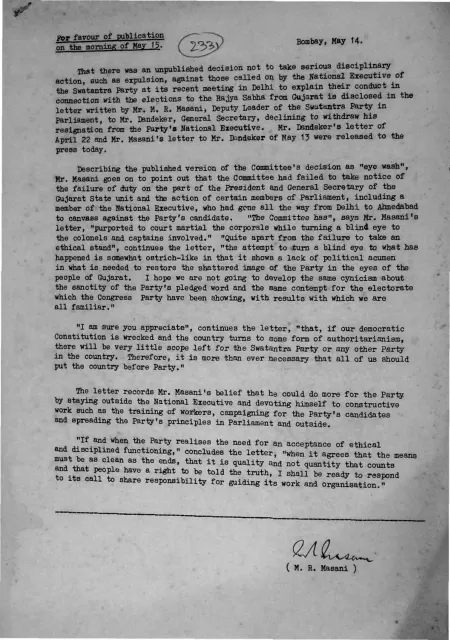
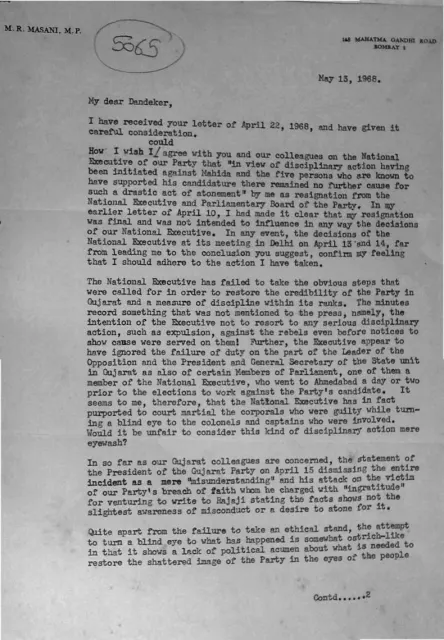
Masani’s 13 May reply declines the request. He maintains that his resignation was final and reflects the National Executive’s failure to restore the party’s credibility in Gujarat or enforce discipline consistently. He criticizes the Executive for ignoring alleged misconduct by senior party figures while acting against its opponents, and warns that such conduct is damaging public faith in political parties and parliamentary democracy. Masani therefore proposes to remain outside the National Executive and Parliamentary Board while undertaking “constructive work,” including training young workers, spreading the party’s principles, and supporting good candidates. The exchange ends with his willingness to resume responsibility if the party accepts ethical and disciplined functioning.
Key points
- N. Dandeker reports that the Swatantra Party’s Central Parliamentary Board and National Executive unanimously asked Minoo Masani to withdraw his resignation.
- Dandeker presents the resignation as an unnecessary act of atonement after disciplinary proceedings were initiated against Mahida and five supporters of his candidacy.
- Masani argues that the party failed to restore its credibility in Gujarat and failed to apply discipline consistently.
- Masani alleges that party leaders ignored misconduct by senior figures while acting against their political opponents.
- The correspondence links party ethics and internal discipline to public confidence in parliamentary democracy.
- Masani proposes constructive political work outside the party’s National Executive and Parliamentary Board, including training young workers and campaigning for good candidates.
- Masani leaves open a future return to responsibility if the party accepts ethical, disciplined, and principle-based functioning.
Metadata and summary are AI-extracted from the source PDF and reviewed for editorial accuracy. The original work is available via the Read PDF tab above (where present); paragraph-level citation inside the PDF is deferred to a future engagement.