letter
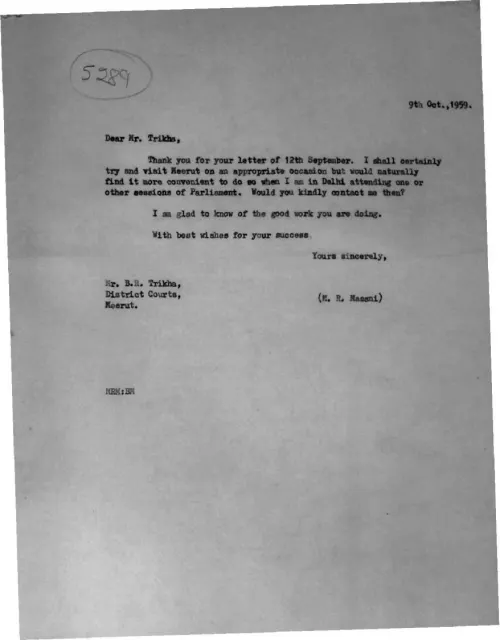
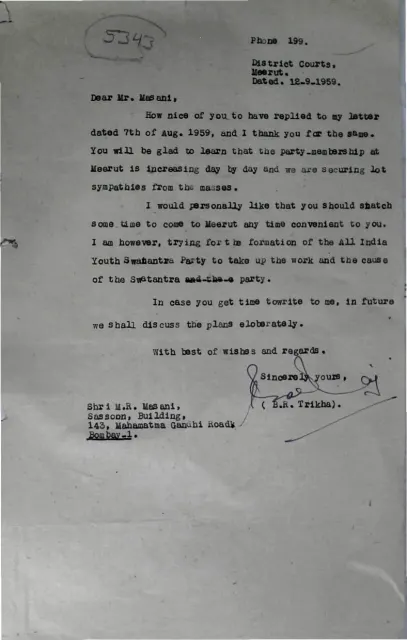
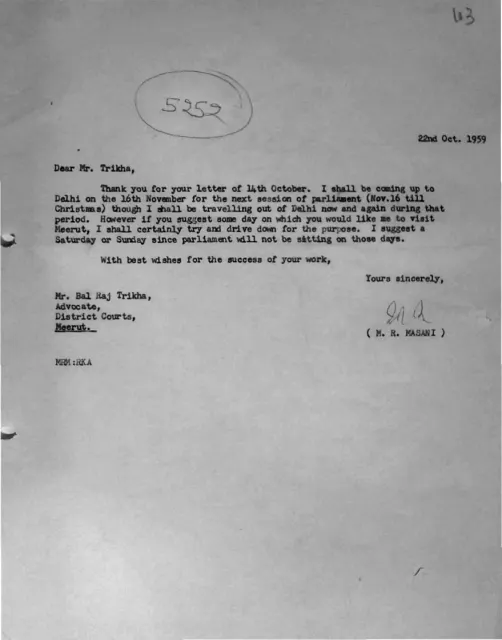
Letter to Mr Minoo Masani
SWATANTRA PARTY · Meerut · 1959
2 pages
Summary
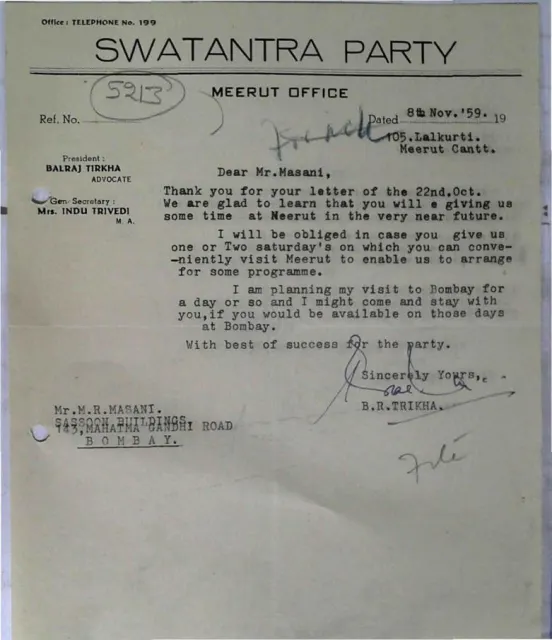
This two-page 1959 Swatantra Party file contains a typed letter from the party’s Meerut Office, signed by B. R. Trikha and addressed to M. R. Masani. Dated 8 November 1959, the letter welcomes Masani’s planned visit to Meerut, requests that he suggest one or two Saturdays for a programme, and mentions the sender’s own proposed visit to Bombay. Its tone is organisational and supportive, closing with “With best of success for the party.”
The second page is a separate, undated typescript whose relationship to the letter cannot be established from the rendered pages. It proposes a leaflet campaign aimed at informing village peasants and middle-class readers, distributing 2,000 copies selectively to parliamentarians, press representatives, newspaper offices, government secretaries, and committee members. The text presents the campaign as a response to communism, Nehruvian socialism, and “congressite non-violent fascism,” and calls for direct criticism of Jawaharlal Nehru’s security and economic policies. It also invokes Nehru’s relationship with Khrushchev and Chou-en-lai, while referring to the “KHADI OFFICE” as an organisation with long experience among rural and middle-class audiences.
Key points
- B. R. Trikha’s Meerut Office letter to M. R. Masani is dated 8 November 1959.
- The letter coordinates Masani’s forthcoming Meerut visit and Trikha’s possible visit to Bombay.
- The second page appears to be an undated enclosure or separate typescript rather than a continuous part of the letter.
- The typescript proposes a 2,000-copy leaflet campaign directed at political, governmental, journalistic, and committee audiences.
- Its stated purpose is to acquaint and inform readers about communism, Nehruvian socialism, and “congressite non-violent fascism.”
- The document advocates direct criticism of Nehru’s security and economic policies.
- The second page frames Nehru’s “understanding” with Khrushchev and Chou-en-lai as a subject requiring public exposure.
Metadata and summary are AI-extracted from the source PDF and reviewed for editorial accuracy. The original work is available via the Read PDF tab above (where present); paragraph-level citation inside the PDF is deferred to a future engagement.