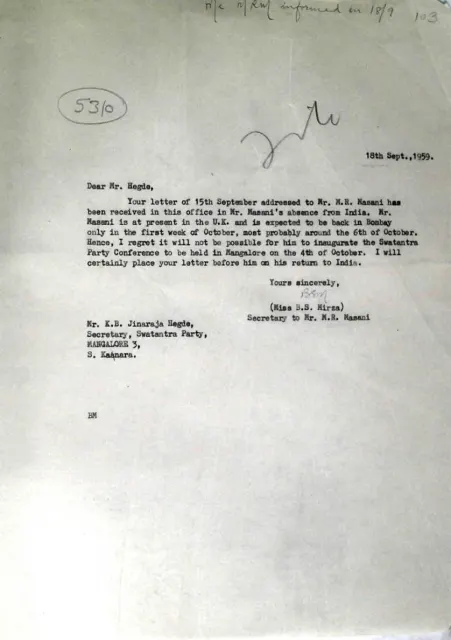
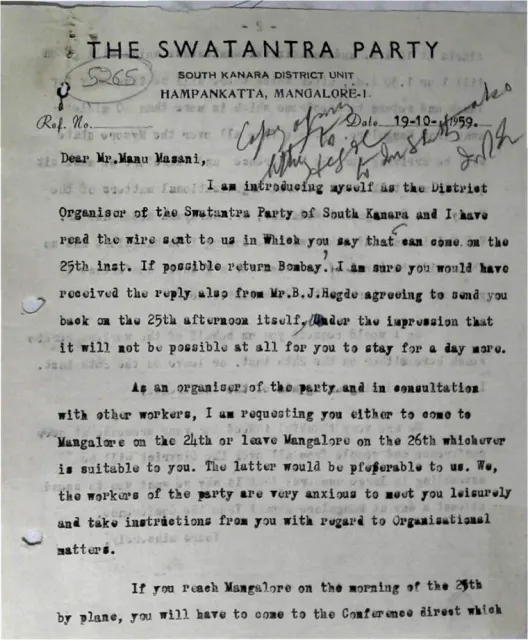
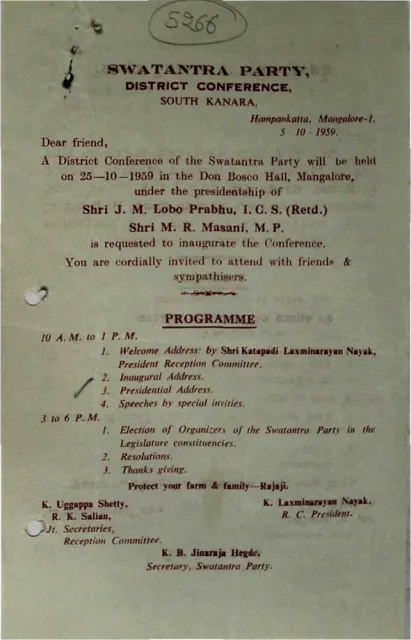
letter
Letter to Mr Minoo Masani
Mangalore-3 · 1959
4 pages
Summary
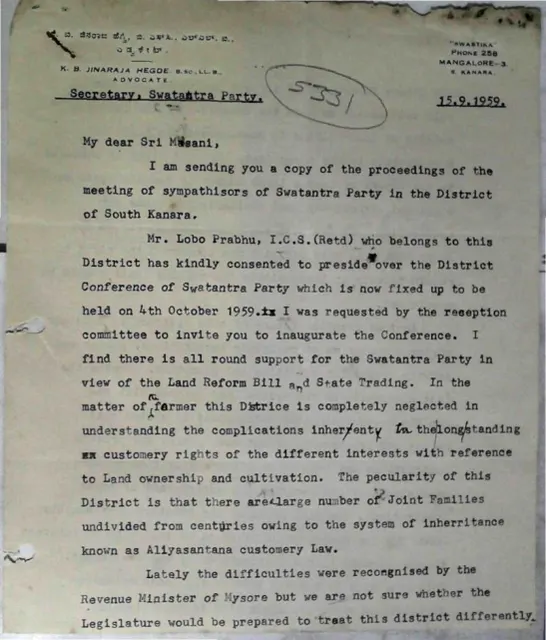
This 15 September 1959 letter from K. B. Jinaraja Hegde, Secretary of the Swatantra Party, invites Minoo Masani to inaugurate the party’s South Kanara district conference in Mangalore on 4 October 1959. Hegde reports local support for the party in response to the Mysore Land Reforms Bill and state trading, arguing that the proposed reforms insufficiently account for the district’s distinctive landholding, tenancy, inheritance, and religious-institution arrangements. He highlights the prevalence of undivided joint families under Aliyasantana customary law and warns that recognising landowners’ rights to resume land for self-cultivation could displace large numbers of tenants.
The letter also objects to the Bill’s treatment of public and private religious institutions, temples, charitable trusts, and educational establishments. Hegde states that South Kanara has about 3,500 such institutions and describes the proposed confiscation and compensation provisions as destructive of their existing social functions. He notes planned conferences at Udupi and Hubli to protest the Bill, describes arrangements for Masani’s proposed visit and public meetings, and encloses or follows with minutes of a 14 September meeting of Swatantra Party sympathisers at Karkala. The document is complete as rendered; it has no printed title.
Key points
- Hegde asks Minoo Masani to inaugurate the Swatantra Party’s South Kanara district conference in Mangalore on 4 October 1959.
- The letter presents opposition to the Mysore Land Reforms Bill and state trading as sources of local support for the Swatantra Party.
- It argues that the Bill does not adequately address South Kanara’s Aliyasantana customary inheritance system and its many undivided joint families.
- Hegde warns that landowners’ resumption rights could displace tenants, and supports recognising joint families’ right to retain tenancy within the ceiling limit.
- The letter protests the Bill’s proposed treatment of public and private religious institutions, temples, charitable trusts, and educational establishments.
- It claims that roughly 3,500 religious institutions in the district could be severely affected and describes their land income as supporting temples, mutts, kitchens, and students.
- The enclosed meeting record shows early organisational activity, membership recruitment, reception-committee formation, and plans for the district conference.
Metadata and summary are AI-extracted from the source PDF and reviewed for editorial accuracy. The original work is available via the Read PDF tab above (where present); paragraph-level citation inside the PDF is deferred to a future engagement.