pamphlet
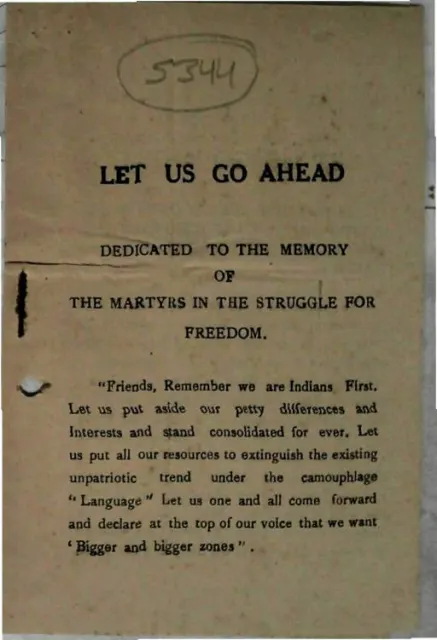
LET US GO AHEAD
(IS NOT THE AGITATION FOR LINGUISTIC PROVINCES REACTIONARY AND WILL IT NOT PUT THE CLOK BACK-WARDS?)
Jinthri, via Song. · 1958
12 pages
Summary
This 12-page pamphlet, signed by J. R. Manjeri and dated October 1958, argues against the agitation for linguistic provinces, particularly the division of Bombay State into Maha-Gujarat and Samyukta Maharashtra. It acknowledges the grief, anger, and violence surrounding the August 1956 decision to retain a bilingual Bombay State, but contends that Parliament’s decision prevented a more dangerous national crisis. The pamphlet presents linguistic reorganisation as, at best, a temporary patch that leaves underlying political and economic problems unresolved.
The argument locates the controversy in competing economic interests, especially Bombay City’s role as an employment and industrial centre for Maharashtrians, Gujaratis, Madrasis, and others. Manjeri criticises political leaders for mobilising legitimate regional grievances through the language issue, and urges intellectuals to explain the economic causes of the conflict, promote industrial development and fair distribution, and help people understand their shared national interests. The pamphlet closes with an appeal to leaders to put India first, reject linguistic chauvinism, and seek a larger national settlement rather than “bigger and bigger zones.”
Key points
- The pamphlet defends the 1956 decision to retain a bilingual Bombay State.
- It argues that linguistic provincialism risks intensifying conflict between neighbouring states.
- It identifies economic interests, employment patterns, and Bombay City’s industrial importance as central causes of the dispute.
- It warns that language-based agitation may obscure deeper economic grievances and reproduce the dangers that preceded Partition.
- It criticises leaders for exploiting regional dissatisfaction and patriotic sentiment for political ends.
- It assigns the intelligentsia a responsibility to explain economic and social realities to the public.
- It advocates industrial development, fair distribution, national solidarity, and a politics that places India before regional claims.
Metadata and summary are AI-extracted from the source PDF and reviewed for editorial accuracy. The original work is available via the Read PDF tab above (where present); paragraph-level citation inside the PDF is deferred to a future engagement.