Summary
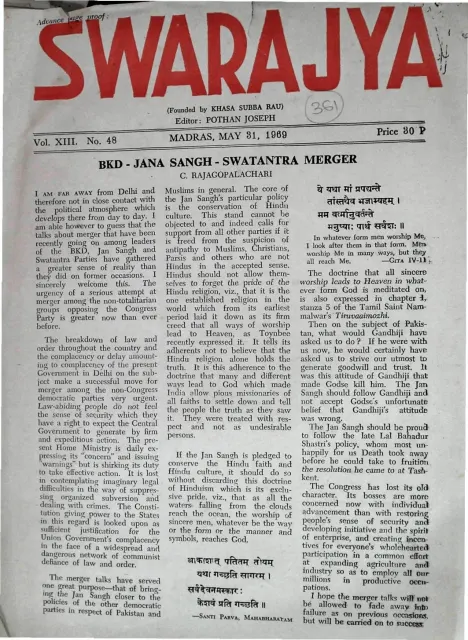
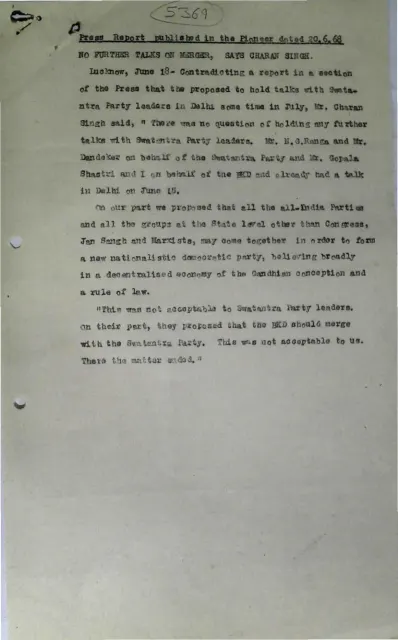
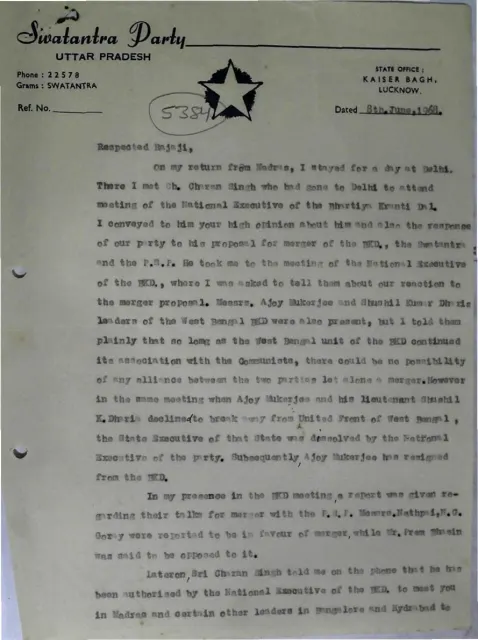
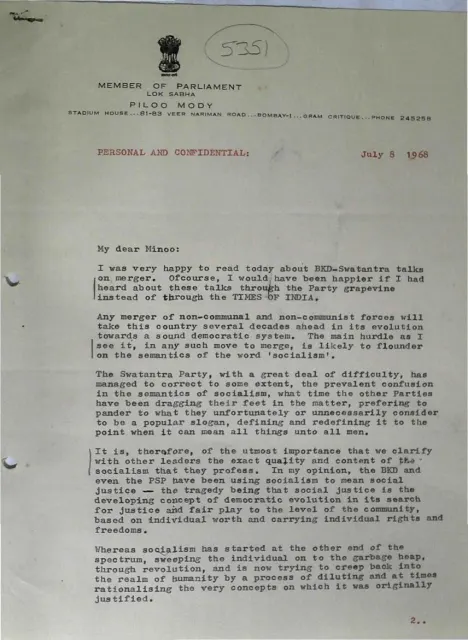
In this letter dated July 8, 1968, Piloo Mody welcomes reports of merger talks between the BKD and the Swatantra Party, arguing that a union of non-communal and non-communist forces could advance India’s evolution toward a sound democratic system. He identifies the central obstacle as the parties’ differing uses of the word “socialism,” and urges their leaders to clarify both the meaning and practical content of the socialism they profess.
Mody contrasts the Swatantra Party’s interpretation of socialism as social justice, democratic evolution, fair play, individual worth, and individual rights and freedoms with what he describes as socialism’s revolutionary and collectivist origins. He recommends defining principles and policies through concrete examples, cautions against allowing Rajaji’s views to remain unexamined, and suggests that the merger should be prepared through propaganda at the lower levels of both parties in order to build enthusiasm and momentum.
Key points
- Mody supports merger talks between the BKD and the Swatantra Party as a possible advance for democratic politics.
- He argues that disagreement over the semantics of “socialism” threatens to derail the proposed merger.
- He presents the Swatantra and PSP usage of socialism as meaning social justice through democratic evolution, fair play, individual worth, rights, and freedoms.
- He contrasts this with a revolutionary conception that subordinates or sweeps away the individual.
- He calls for a precise statement of principles and policies, illustrated through concrete applications.
- He recommends preparatory propaganda among party members to generate enthusiasm for the merger.
Metadata and summary are AI-extracted from the source PDF and reviewed for editorial accuracy. The original work is available via the Read PDF tab above (where present); paragraph-level citation inside the PDF is deferred to a future engagement.