pamphlet
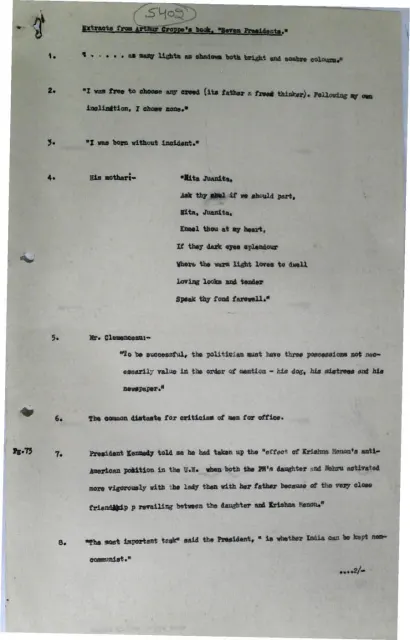
Extracts from Arthur Croppe's book, "Seven Presidents."
2 pages
Summary
This two-page English extract sheet, headed as material from Arthur Croppe’s book “Seven Presidents,” assembles numbered quotations and reported observations about politics, public office, leadership, and international affairs. The selections range from reflections on personal freedom and individual temperament to Clemenceau’s joke about the possessions useful to a politician and a general observation about the common distance between critics and holders of office.
The second page concentrates on mid-century foreign-policy and leadership judgments. It attributes claims to President Kennedy about Krishna Menon’s anti-American position, India’s prospects of remaining non-communist, the Kennedy administration’s support for Indonesia against the Dutch in West Irian, and the Portuguese enclaves in India. It also includes characterizations of Nixon and Robert Kennedy, a quotation from Rudyard Kipling’s “Gods of the Market Place,” and a reference to the 1946 U.N. report. The sheet contains no byline, publisher, date, or explanation of how the extracts were selected.
Key points
- The sheet presents seventeen numbered extracts from the book identified as Arthur Croppe’s “Seven Presidents.”
- Several selections address freedom of conscience, independent choice, and the relationship between individual inclination and inherited creed.
- Political leadership is treated through aphorisms about politicians, critics of officeholders, and the emotional or rhetorical qualities of public figures.
- The extracts report President Kennedy’s views on India, communism, Krishna Menon, and mid-century international conflicts involving Indonesia and Portugal.
- The sheet contrasts or characterizes Kennedy, Nixon, Robert Kennedy, and other political actors without providing sustained narrative context.
- Rudyard Kipling’s 1919 poem “Gods of the Market Place” is used to frame a criticism of material abundance without non-material fulfilment.
- The document is an extract sheet rather than a complete presentation of the source book, and its bibliographic details are not visible.
Metadata and summary are AI-extracted from the source PDF and reviewed for editorial accuracy. The original work is available via the Read PDF tab above (where present); paragraph-level citation inside the PDF is deferred to a future engagement.