essay
IN SOVIET RUSSIA
Moscow · 1927
12 pages
Summary
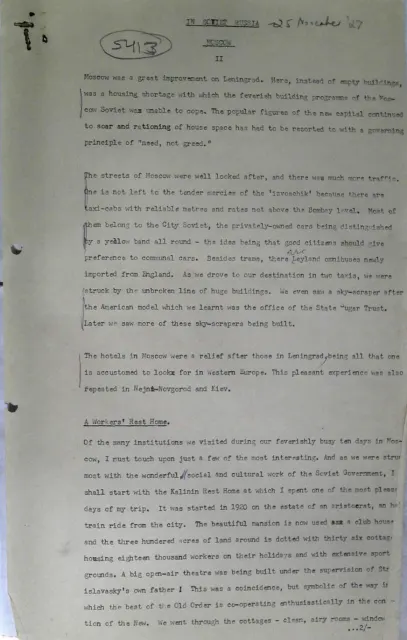
In the rendered pages, the author describes Moscow as more developed and better organised than Leningrad, while acknowledging a severe housing shortage and the rationing of living space according to the principle of “need, not greed.” The account highlights municipal taxis, imported buses, large-scale construction, and more comfortable hotels, presenting Soviet urban administration as both materially ambitious and socially managed.
In the rendered pages, particular attention is given to institutions intended to improve everyday life. The Kalinin Rest Home provides accommodation, food, recreation, a large library, and access to translated literature for workers. The author also records the presence of Chinese, Indian, Malayan, and African students studying Marxist politics and economics in Moscow, including their favourable account of Soviet racial equality. The “Children’s Republic” is presented as an experiment in liberty, self-government, practical education, and laboratory-style teaching for homeless children. The final section seen describes a People’s Court in which an elected worker serves as judge, factory workers act as assessors, and an advisory bureau provides free legal assistance to disadvantaged people. The pages therefore contrast Soviet institutions with Western social inequality, while also revealing the author’s admiration for organised social provision and participatory administration.
Key points
- Moscow is portrayed as more orderly and prosperous-looking than Leningrad, despite a serious housing shortage and rationing of house space.
- Municipal transport, regulated taxi fares, and extensive building projects are presented as evidence of Soviet urban administration.
- The Kalinin Rest Home combines worker accommodation, food, sport, cultural facilities, and a large library.
- The library’s popular translations include works by Upton Sinclair, Rabindranath Tagore, and Sarojini Naidu.
- International students in Moscow are described as studying Marxist politics and economics and receiving free board, lodging, and allowances.
- The Children’s Republic combines schooling and vocational training with extensive liberty and child self-government.
- The People’s Court is described as a participatory institution with an elected worker judge, worker assessors, and free legal aid for disadvantaged litigants.
Metadata and summary are AI-extracted from the source PDF and reviewed for editorial accuracy. The original work is available via the Read PDF tab above (where present); paragraph-level citation inside the PDF is deferred to a future engagement.