
letter
General Secretarys letter no-304
swatantra party national headquarters sassoon building, 143, mahatma gandhi road, bombay 1. · bombay 1 · 1973
2 pages
Summary
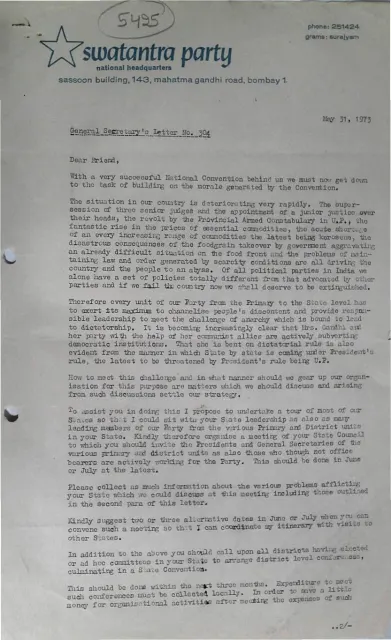
This two-page Swatantra Party circular, dated May 31, 1973, is headed “General Secretary’s Letter No. 304” and signed by Madhu Mehta as General Secretary. It presents India’s rapidly deteriorating political and economic situation as a crisis requiring urgent party mobilisation. The letter cites the Supreme Court’s supersession of senior judges, the appointment of a junior judge as Chief Justice, the revolt by the Provincial Armed Constabulary in Uttar Pradesh, rising prices, shortages, foodgrain nationalisation, and the spread of martial-law conditions. It argues that the Swatantra Party’s distinct policies and its defence of democratic institutions give it a special responsibility to channel public discontent through responsible political leadership rather than allowing disorder to lead to dictatorship.
The letter directs state units to organise meetings with state, district, and primary-level leaders; collect information on local problems; arrange district conferences culminating in a State Convention; publish souvenirs and collect local advertisements to fund the activity; and propose dates that can be coordinated with the General Secretary’s tour of other states. It also calls for an immediate meeting of each State Executive to mobilise district units and settle the date and venue of a regional council. No standalone title or recipient is printed, and the letter’s broader organisational follow-up beyond these two pages is not available here.
Key points
- The letter describes a rapidly worsening political and economic situation in India in 1973.
- It cites judicial supersession, unrest in Uttar Pradesh, inflation, shortages, foodgrain nationalisation, and deteriorating law and order as signs of crisis.
- It portrays the Swatantra Party as uniquely committed to policies different from those of other Indian parties.
- It warns that public disorder and political mismanagement could lead to dictatorship and argues for responsible party leadership.
- It instructs state units to convene meetings with district and primary-level office-bearers and collect information on local problems.
- It requires district conferences culminating in State Conventions, with local fundraising through souvenirs and advertisements.
- It asks State Executives to settle regional council dates and venues in coordination with the General Secretary’s inter-state tour.
Metadata and summary are AI-extracted from the source PDF and reviewed for editorial accuracy. The original work is available via the Read PDF tab above (where present); paragraph-level citation inside the PDF is deferred to a future engagement.
Related across the archive
 Primary workGeneral Secretary's Letter No. 222
 Primary workFIFTH PARTY ELECTIONS- 1973
 Primary workDraft minutes of the meeting of the Executive Committee of Swatantra Party, Bombay Region, held on Wednesday the 11th March, 1970
 ExcerptThe Party or the People?
 ExcerptThe Role of Judiciary in Parliamentary Democracy by Justice M.C. Chagla