letter
24th Constitution Amendment Bill
Swatantra Party national headquarters · Bombay · 1971
5 pages
Summary
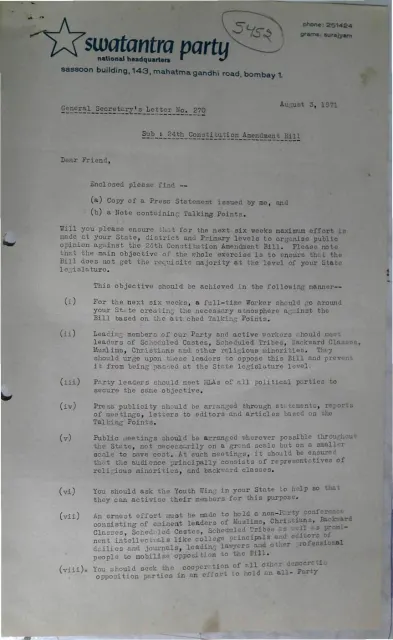
This five-page Swatantra Party document, dated 2–3 August 1971, comprises General Secretary R. C. Cooper’s Letter No. 270, a press statement, and talking points opposing the Constitution (Twenty-Fourth Amendment) Bill. The document argues that the Bill’s proposed amendment to Article 368 would enable Parliament to amend the Fundamental Rights chapter, reversing the Supreme Court’s position in the Golak Nath case and allowing Parliament to alter constitutional protections with a steamroller majority. It urges party workers to organize public opinion over six weeks and, crucially, to prevent the Bill from securing the approval of at least half of India’s state legislatures.
The document presents Fundamental Rights as essential safeguards for minorities and weaker sections, specifically naming Muslims, Christians, Scheduled Castes, Scheduled Tribes, and backward classes. Its operational recommendations include mobilizing full-time workers, contacting community leaders and legislators, arranging press coverage and public meetings, involving the party’s Youth Wing, convening a non-party conference, and cooperating with other democratic opposition parties. The press statement and talking points frame the amendment as a threat not only to constitutional limitations on Parliament but also to religious and communal security.
Key points
- The document opposes the Constitution (Twenty-Fourth Amendment) Bill of 1971 and its proposed amendment to Article 368.
- It argues that the Bill would allow Parliament to amend or withdraw Fundamental Rights.
- The Swatantra Party’s immediate objective is to prevent the Bill from obtaining approval from 50 percent of the state legislatures.
- The document identifies minorities, Scheduled Castes, Scheduled Tribes, and backward classes as especially vulnerable to the amendment.
- It calls for a coordinated six-week campaign involving party workers, community leaders, legislators, journalists, lawyers, educators, and opposition parties.
- The supplied materials include a general secretary’s organizing letter, a press statement, and internal talking points.
- The document cites Motilal Nehru and Frank Anthony in support of treating Fundamental Rights as durable constitutional safeguards.
Metadata and summary are AI-extracted from the source PDF and reviewed for editorial accuracy. The original work is available via the Read PDF tab above (where present); paragraph-level citation inside the PDF is deferred to a future engagement.