letter
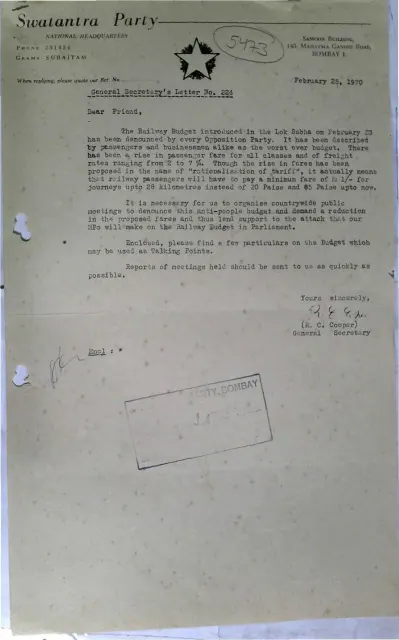
General Secretary's Letter No. 224
Swatantra Party · Bombay 1 · 1970
3 pages
Summary
Dated February 25, 1970, General Secretary R. C. Cooper’s letter to Swatantra Party workers condemns the Railway Budget introduced in the Lok Sabha two days earlier. It characterizes the budget as an anti-people measure that raises passenger fares and freight rates, and calls for nationwide public meetings, protests, and demands for reduced fares. The letter encloses a two-page briefing note, “The Railway Budget—What It Means to the Common Man,” which translates the proposed increases into examples for third-class, first-class, season-ticket, platform-ticket, and goods traffic users.
The enclosed note argues that higher railway charges will increase the prices of everyday goods, placing the burden on ordinary consumers. It juxtaposes press quotations and preliminary comments by Swatantra Party leaders and MPs with a call for party workers to mobilise consumers and commuters, organise protest meetings and rallies, and launch a signature campaign addressed to the Railway Minister. The document frames the Railway Budget as evidence of inefficient and inflationary government policy, and attacks its presentation as “socialism.”
Key points
- The Swatantra Party presents the February 1970 Railway Budget as the worst-ever budget and an anti-people measure.
- The letter reports increases in passenger fares and freight rates, including a rise in the minimum fare for short journeys.
- The enclosed briefing note gives concrete fare comparisons for Bombay–Madras and New Delhi–Madras travel.
- The note highlights increases affecting first-class passengers, monthly season-ticket holders, platform-ticket purchasers, and goods traffic.
- It argues that higher freight charges on items such as vegetables, sugar, salt, kerosene, cotton, piece goods, oil cakes, newspapers, and other commodities will raise prices.
- The document uses quotations from Indira Gandhi and newspaper-reported remarks to challenge the government’s description of the increases as socialism or marginal.
- Party workers are instructed to organise public meetings, rallies, consumer and commuter mobilisation, and a signature campaign against the budget.
Metadata and summary are AI-extracted from the source PDF and reviewed for editorial accuracy. The original work is available via the Read PDF tab above (where present); paragraph-level citation inside the PDF is deferred to a future engagement.