
letter
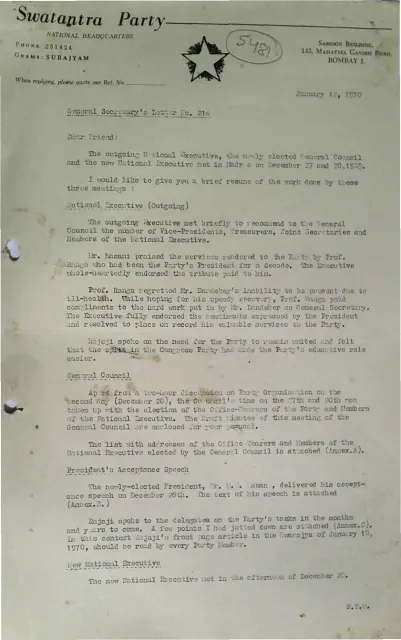
General Secretary's Letter No. 216
Swatantra Party · Bombay · 1970
19 pages
Summary
This January 12, 1970 letter from Swatantra Party General Secretary R.C. Cooper reports on the party’s December 27–28, 1969 meetings in Madras. It records the outgoing National Executive’s recommendations, the constitution of a Central Parliamentary Board, the election of M.R. Masani as president and R.C. Cooper as general secretary, and the appointment of treasurers, joint secretaries, and twenty members of the new National Executive. The letter also announces plans to prepare policy papers on public-sector and transport communications, food and agriculture, unemployment and housing, and invites members to submit suggestions before the next Executive meeting.
Key points
- The letter summarizes meetings of the outgoing Executive, General Council, and newly elected National Executive held on December 27 and 28, 1969.
- The Central Parliamentary Board includes M.R. Masani as president, R.C. Cooper as general secretary, C. Rajagopalachari, N.G. Ranga, Dahyabhai V. Patel, and state-level party leaders.
- The General Council adopted the structure of five vice-presidents, two treasurers, five joint secretaries, and twenty members of the National Executive.
- Secret-ballot results for vice-presidents, joint secretaries, and National Executive members are recorded in detail, along with vote totals and withdrawals.
- The party planned a more detailed statement of its political attitude toward other parties and position papers on public-sector and transport communications, food and agriculture, unemployment, and housing.
- M.R. Masani’s acceptance speech presents the Swatantra Party as a defender of India’s independence and constitutional democracy and as an opponent of permit-licence raj, excessive planning, and state control.
- Masani argues that the party’s central organizational problems are weak cadres, insufficient discipline, inadequate public communication, and neglect of groups including youth, women, minorities, consumers, landless labourers, and other underprivileged sections.
Metadata and summary are AI-extracted from the source PDF and reviewed for editorial accuracy. The original work is available via the Read PDF tab above (where present); paragraph-level citation inside the PDF is deferred to a future engagement.
Related across the archive
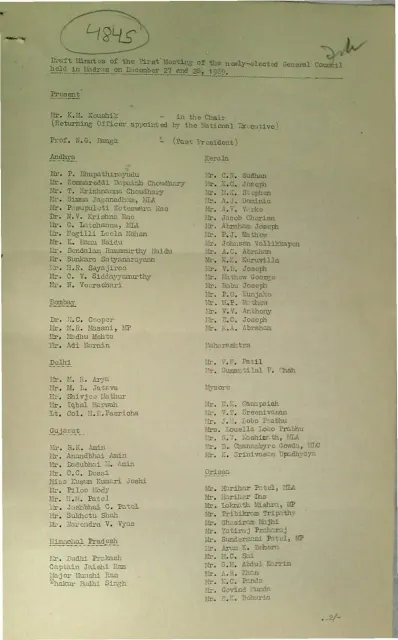 Primary workDraft Minutes of the First Meeting of the newly-elected General Council held in Madras on December 27 and 28, 1969.
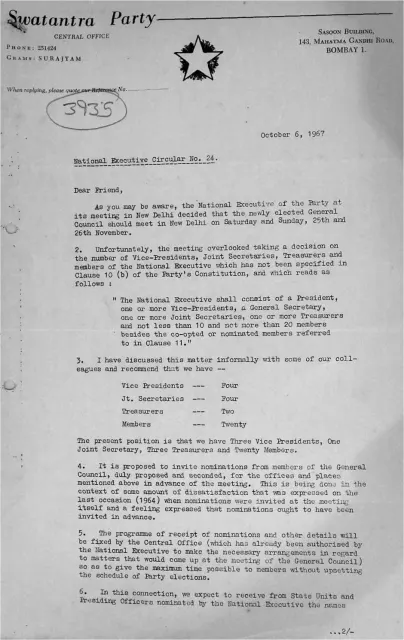 Primary workNational Executive Circular No. 24.
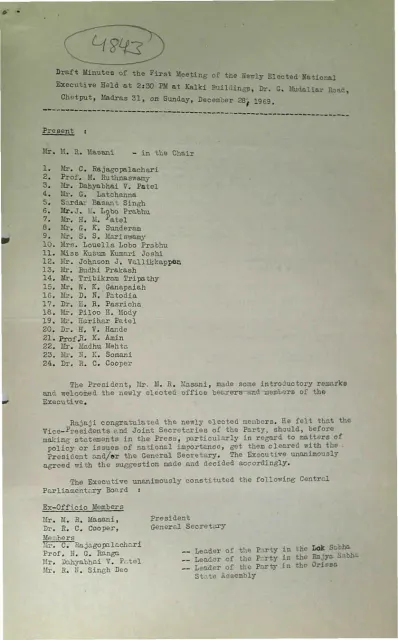 Primary workDraft Minutes of the First Meeting of the Newly Elected National Executive Held at 2:30 PM at Kalki Buildings, Dr. G. Mudaliar Road, Chepaut, Madras 31, on Sunday, December 28, 1969.
 ExcerptCommunity Development
 ExcerptThe Swatantra Manifesto